How to Rank a Dental Clinic on Google?
Dental SEO helps dental clinics improve their visibility in Google Search and Google Maps so prospective patients can discover their services when searching online. By combining technical SEO, local search optimization, useful dental content, website…

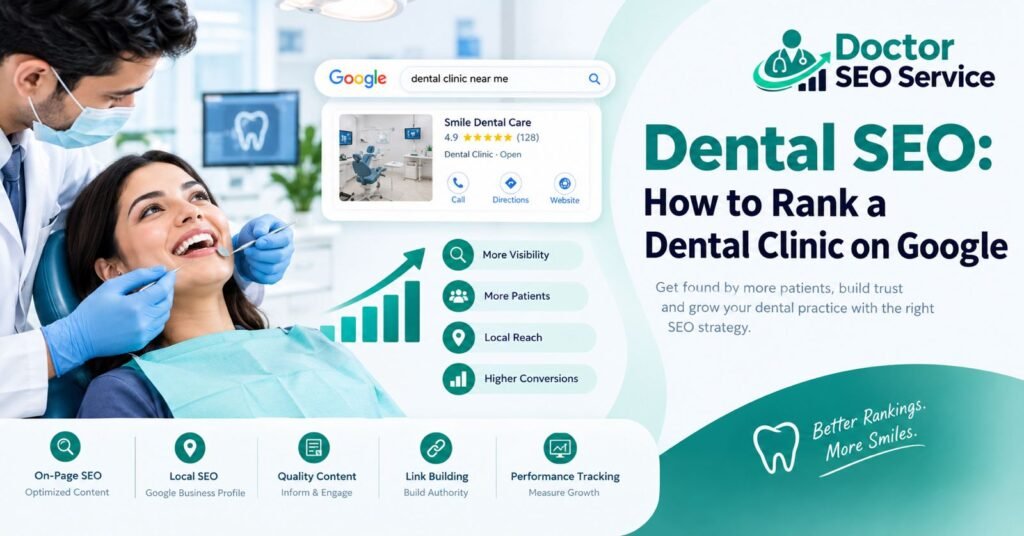
Dental SEO helps dental clinics improve their visibility in Google Search and Google Maps so prospective patients can discover their services when searching online. By combining technical SEO, local search optimization, useful dental content, website improvements, and reputation management, dental practices can build a stronger online presence and generate more relevant appointment enquiries.
Whether you operate a single dental practice, a multispecialty dental clinic, or a network of dental centers, a well-planned SEO strategy can help you reach people searching for dental services in your area.
However, ranking a dental clinic on Google requires more than adding keywords to a website. Your clinic needs useful service pages, accurate business information, a technically accessible website, trustworthy content, and a positive experience for prospective patients.
In this guide, Doctor SEO Service explains how dental SEO works, which optimization strategies matter most, how to improve local search visibility, and how to prepare your dental website for evolving AI-powered search experiences.
What Is Dental SEO?
Dental SEO, or dental search engine optimization, is the process of improving a dental clinic’s website and online presence to increase its visibility in relevant organic search results.
It includes several interconnected activities:
- On-page SEO: Optimizing page titles, headings, content, images, and internal links.
- Technical SEO: Improving crawling, indexing, website structure, and page performance.
- Local SEO: Helping search engines understand where your practice operates and which services it provides.
- Content marketing: Publishing useful information about dental treatments, oral health, and common patient questions.
- Reputation management: Supporting a trustworthy online presence through genuine reviews and accurate business information.
- Off-page SEO: Earning relevant mentions and links through legitimate outreach and useful resources.
- AI search optimization: Making website content clear, accessible, and informative for search engines and AI-powered discovery systems.
The objective is not simply to attract more website visitors. It is to help relevant people discover your clinic, understand your services, and take an appropriate next step.
Why Is Dental SEO Important for Your Dental Clinic?
People often research dentists, compare treatment options, and look for nearby clinics before making an appointment.
If your dental practice has limited online visibility, potential patients may have difficulty discovering your services even when your clinic is well suited to their needs.
A structured dental SEO strategy can support several business objectives.
1. Improve Visibility in Relevant Google Searches
Your website can target relevant searches related to your services, such as dental implants, orthodontics, root canal treatment, preventive dentistry, and cosmetic dentistry.
For example, a dental clinic offering implant treatment may benefit from a dedicated page explaining the service, its suitability, the consultation process, and how patients can contact the clinic.
Each page should address a clear search intent rather than repeating the same keywords across multiple URLs.
2. Reach Patients Searching Locally
Many dental practices primarily serve a particular city, neighborhood, or surrounding area.
Local SEO helps search engines understand your business location and the services you offer. A well-maintained Google Business Profile, accurate contact information, and useful location-specific content can support your local visibility.
3. Build Trust Before the First Appointment
Patients want to understand who provides their care, which services are available, and how to contact the practice.
Detailed dentist biographies, accurate treatment information, clear contact details, and genuine patient feedback can help people evaluate your clinic.
4. Create Long-Term Marketing Value
Paid advertising can generate visibility while campaigns are active. SEO focuses on improving your website’s ability to attract relevant organic traffic over time.
SEO requires ongoing maintenance, and results are not guaranteed. Nevertheless, useful content and a technically sound website can continue supporting your online presence after publication.
10 Dental SEO Strategies to Help Your Clinic Rank on Google
1. Conduct Dental Keyword Research
Keyword research helps identify the terms people use when looking for dental services.
Start by identifying your clinic’s core treatments, target locations, and business priorities.
Examples include:
| Keyword | Search Intent |
|---|---|
| Dental clinic near me | Local discovery |
| Dentist in [city] | Local provider search |
| Dental implants in [city] | Treatment-related search |
| Root canal treatment | Treatment research |
| Invisalign dentist in [city] | Treatment and provider search |
| Emergency dentist in [city] | Urgent service search |
| Cosmetic dentist near me | Local commercial search |
| Dental implant cost | Cost-related research |
These examples are starting points, not verified search-volume or ranking opportunities. Validate them using tools such as Google Search Console, Google Keyword Planner, and relevant search results.
Practical recommendation: Group keywords by search intent and map each group to the most appropriate page.
For instance, a dedicated dental implant page should explain implant services rather than redirecting every implant-related search to the homepage.
Avoid creating separate pages for minor keyword variations when the underlying search intent and useful content are essentially identical.
2. Optimize Your Google Business Profile
Your Google Business Profile is an important component of local SEO for eligible dental practices.
Review your profile to ensure that the business name, address, phone number, opening hours, website, and other details are accurate.
Important optimization activities include:
- Selecting the most appropriate primary business category.
- Adding relevant secondary categories where justified.
- Providing accurate service information.
- Uploading genuine photographs of the clinic and facilities.
- Keeping opening hours updated.
- Responding professionally to patient reviews.
- Monitoring profile interactions and available performance metrics.
Ask patients for honest reviews without offering incentives in exchange for positive feedback. Do not create fake reviews or selectively manipulate ratings.
Google’s local results are influenced by relevance, distance, and prominence. Profile optimization can help, but it cannot guarantee a particular Maps position.
3. Create Dedicated Dental Service Pages
A common dental website problem is placing every treatment on a single services page.
When your clinic provides multiple treatments, consider creating dedicated pages for the most important services.
Depending on your actual offerings, these might include:
- Dental implants.
- Root canal treatment.
- Teeth whitening.
- Orthodontics and clear aligners.
- Dental crowns and bridges.
- Veneers and cosmetic dentistry.
- Pediatric dentistry.
- Preventive dental care.
- Emergency dental services.
Each page should explain the relevant service clearly and accurately.
A useful treatment page may include an overview, common reasons patients seek the service, the consultation process, appropriate treatment considerations, frequently asked questions, practitioner information, and a contact option.
Do not publish treatment claims, guarantees, or clinical recommendations without appropriate professional review.
4. Improve On-Page SEO Elements
On-page SEO helps search engines and visitors understand each page.
Review the following elements:
SEO title: Write a unique, descriptive title that reflects the page’s subject and search intent.
Example: Dental Implants in Delhi | Dental Implant Consultation
Meta description: Summarize the page accurately and explain why it may be useful to the reader.
H1 heading: Use one clear primary heading that describes the page’s main purpose.
H2 and H3 headings: Organize the information into meaningful sections.
URL structure: Keep URLs descriptive and easy to understand.
Example: /dental-implants/
Image optimization: Use descriptive filenames, appropriate compression, and meaningful alternative text for informative images.
Internal links: Connect relevant treatment pages, dentist profiles, educational articles, and contact pages.
Use keywords naturally. Repeating the same phrase excessively can make content less readable without guaranteeing better rankings.
5. Publish Helpful Dental Blog Content
A dental blog can answer patient questions and introduce your practice to people researching oral health and treatment options.
Potential topics include:
- How to Choose the Right Dentist for Your Family.
- Dental Implants vs. Dental Bridges: What Patients Should Know.
- What to Expect During a Root Canal Consultation.
- How to Maintain Oral Hygiene Between Dental Visits.
- Questions to Ask Before Starting Orthodontic Treatment.
- What to Consider When Comparing Dental Clinics.
- How to Find a Dentist Near You.
- Common Questions About Professional Teeth Whitening.
Medical and dental information should be accurate, appropriately sourced, and reviewed by qualified professionals when necessary.
Avoid producing large numbers of nearly identical articles simply to target different keywords or locations. Each article should offer genuine value to readers.
6. Strengthen Your Website’s Technical SEO
Even useful content can struggle to perform when important technical problems prevent search engines from accessing or understanding the website.
A technical SEO audit should examine:
- Whether important pages are crawlable and indexable.
- XML sitemap availability and accuracy.
- Robots.txt directives.
- Canonical tags and duplicate URLs.
- Broken internal links and unnecessary redirects.
- Mobile usability.
- Core Web Vitals and page performance.
- Website navigation and information architecture.
- Appropriate structured data.
- Image size and loading behavior.
For example, if your dental implant page accidentally contains a noindex directive, it may not appear in Google’s index.
Correcting that issue may be more important than publishing additional blog posts.
Prioritize technical improvements according to their actual impact rather than treating every automated audit warning as equally urgent.
7. Build a Trustworthy Online Reputation
Patient reviews and accurate business information help people evaluate a dental practice.
Encourage genuine patients to share honest feedback, and respond to reviews professionally.
When replying to a review, protect patient privacy. Avoid confirming that a reviewer received treatment or revealing personal health information, even when responding to a complaint.
You should also ensure that the information displayed across your website and relevant business directories is consistent.
Professional memberships, qualifications, and awards can be included when they are genuine and accurately represented.
Never purchase fabricated testimonials or publish unsupported claims about treatment success rates.
8. Earn Relevant Backlinks and Local Mentions
Backlinks are links from other websites to your website.
Relevant links can help people discover your clinic and provide useful context about your business. However, the quality and relevance of a link matter more than simply accumulating a large number of links.
Potential legitimate opportunities include:
- Local business associations.
- Relevant professional directories.
- Dental education resources.
- Community health initiatives.
- Reputable local publications.
- Expert contributions to relevant publications.
Do not rely on link farms, automated link schemes, or bulk purchases of unrelated backlinks.
A sustainable off-page strategy should prioritize relevance, editorial quality, and genuine value.
9. Optimize Your Dental Website for AI Search
Search experiences increasingly incorporate AI-generated summaries and conversational answers.
Dental practices may want to improve the clarity, accessibility, and reliability of their website content so search engines and AI systems can interpret it appropriately.
Useful practices include:
- Answering common questions directly.
- Using descriptive headings.
- Publishing accurate dental information.
- Identifying authors and qualified reviewers appropriately.
- Maintaining consistent business and practitioner information.
- Connecting related pages through meaningful internal links.
- Using relevant structured data that accurately represents visible content.
- Ensuring important content is accessible to search crawlers.
For example, an article about dental implants can explain what implants are, what a consultation involves, which factors influence treatment suitability, and what questions patients should discuss with their dentist.
This is more useful than repeating the phrase “best dental implant clinic” throughout the page.
Important: No special AI SEO technique guarantees that a clinic will appear in ChatGPT, Gemini, Google AI Overviews, or other AI-powered results. Focus on helpful content, sound technical SEO, accuracy, and a clear website structure.
10. Track Rankings, Website Traffic, and Enquiries
Dental SEO should be evaluated using measurable business objectives.
Useful tools include Google Search Console and Google Analytics, configured appropriately for your website and privacy obligations.
Track indicators such as:
| Metric | Why It Matters |
|---|---|
| Organic clicks | Measures visits from organic search results |
| Search impressions | Shows how often pages appear in eligible search results |
| Relevant search queries | Helps identify the searches bringing visitors to your site |
| Landing-page traffic | Shows which pages attract organic visitors |
| Contact form submissions | Measures tracked enquiries |
| Appointment requests | Indicates potential patient interest |
| Phone enquiries | Helps assess contact activity where reliable tracking is available |
| Conversion rate | Measures the proportion of visitors completing a desired action |
More traffic does not necessarily mean more patients.
A useful SEO campaign should attract relevant visitors and make it straightforward for them to contact the practice.
How Local SEO Helps Dental Clinics Attract Nearby Patients
Local SEO deserves special attention because dental practices often depend on patients within a defined service area.
A strong local SEO strategy connects your business profile, website, services, and location information.
Create Useful Location Pages
If your clinic operates in multiple locations, create separate pages when each location has genuine, distinct information to provide.
A useful location page may include:
- The correct clinic name and address.
- Opening hours and contact details.
- Available dental services.
- Information about the practitioners at that location.
- Directions or relevant accessibility information.
- Genuine photographs of the premises.
- A clear appointment enquiry option.
Avoid creating hundreds of doorway pages that swap city names while offering little unique value.
If you operate only one clinic, concentrate on creating a strong page for that practice rather than publishing misleading pages for locations where you have no presence.
Improve the Patient Contact Experience
A potential patient who finds your website should be able to identify the clinic’s location, understand its services, and contact the practice without difficulty.
Make phone numbers clickable on mobile devices and ensure contact forms work correctly.
If you offer online appointment requests, explain what happens after submission and avoid collecting unnecessary sensitive health information through general marketing forms.
How to Prepare a Dental Website for Google AI Overviews and Conversational Search
Traditional SEO and AI search optimization share important foundations: accessible content, useful answers, accurate information, and a clear website structure.
Dental clinics can support discoverability by organizing their websites around actual services and patient questions.
Use Clear Question-and-Answer Sections
Add relevant FAQs to service pages and educational articles.
For example:
What should I consider when choosing a dental clinic?
Patients may wish to evaluate the dentist’s qualifications, available services, location, communication, hygiene practices, and suitability for their needs.
How do I find a dental clinic near me?
People can use local search results and business profiles to compare nearby providers, review available services, and check contact information.
Answers should be concise where appropriate but detailed enough to address the question accurately.
Implement Appropriate Structured Data
Depending on the page, structured data may help search engines interpret information about your organization, articles, and breadcrumbs.
Possible types include:
OrganizationDentist, where applicable to the actual business and supported by the relevant schema vocabularyArticleorBlogPostingBreadcrumbList
Use the most appropriate type for the entity being described. Ensure the markup matches visible content and follows Google’s structured data policies.
Valid structured data does not guarantee enhanced listings, higher rankings, or AI citations.
Make Important Content Accessible
Ensure important service information is available as readable text and not exclusively embedded in images or inaccessible interface elements.
Maintain accurate canonical tags, XML sitemaps, and crawl settings.
Google’s official SEO documentation explains how search engines discover and interpret website content and is a useful reference for ongoing optimization.
Frequently Asked Questions About Dental SEO
1. How can I rank my dental clinic on Google?
Start with a technically sound website, relevant service pages, accurate business information, and a well-maintained Google Business Profile. Publish helpful dental content, strengthen internal links, earn relevant mentions, and monitor performance using Google Search Console and other suitable analytics tools. Results depend on competition and many other factors.
2. How long does dental SEO take to work?
There is no universal timeline. Outcomes depend on your website’s current condition, local competition, content quality, technical issues, and implementation. Some improvements may become visible earlier than others, but sustainable SEO generally requires ongoing work and measurement.
3. Is Google Business Profile important for dental SEO?
Yes. A properly maintained profile can help eligible dental practices appear in relevant local search and Maps experiences. Accurate details, appropriate categories, genuine reviews, and useful business information can support local discoverability. Profile optimization does not guarantee a particular ranking.
4. Which keywords should a dental clinic target?
Choose keywords that reflect your actual services, target locations, and patients’ search intentions. Examples include dentist in a specific city, dental implants in a specific location, and root canal treatment. Validate keyword opportunities using search data and avoid targeting phrases unrelated to your practice.
5. Does blogging help dental SEO?
Helpful blog articles can answer patient questions, support internal linking, and introduce your website to people researching dental treatments. Articles should be accurate, relevant, and meaningfully different from existing content. Publishing more articles alone does not guarantee higher rankings.
6. Can AI SEO help my dental clinic appear in ChatGPT or Google AI Overviews?
Good SEO practices can help make your website accessible and understandable to search systems. Clear content, reliable information, relevant internal links, and appropriate structured data may support discoverability. However, no agency can guarantee that an AI platform will cite or recommend a specific clinic.
7. Should each dental treatment have its own page?
Important treatments often benefit from dedicated pages when they have distinct information and search intent. For example, dental implants and orthodontics may require different explanations, patient questions, and consultation information. Avoid creating separate pages that merely repeat the same content with minor keyword changes.
8. How do I measure dental SEO success?
Track relevant organic search traffic, impressions, enquiries, appointment requests, conversion rates, and local visibility where measurable. Compare performance against a baseline and consider seasonal changes and business conditions. Rankings are useful indicators, but they should not be the only measure of success.
Improve Your Dental Clinic’s Online Visibility With Doctor SEO Service
Ranking a dental clinic on Google requires a coordinated strategy that combines technical SEO, useful treatment pages, local search optimization, trustworthy content, and ongoing performance measurement.
For practices seeking to improve their visibility, the first step is to identify existing technical problems, understand the most relevant patient searches, and prioritize improvements that support the clinic’s actual services.
At Doctor SEO Service, we provide healthcare-focused SEO and digital marketing solutions designed to help doctors, dental clinics, specialist practices, and hospitals strengthen their online presence.
Whether you want to improve your dental website, optimize local search visibility, develop service pages, or build a more structured content strategy, a tailored SEO plan can help establish a stronger foundation for long-term growth.
Ready to improve your dental website’s visibility?
Explore Doctor SEO Service to learn more about healthcare SEO and digital marketing services.