
SEO for Doctors: How to Get More Patients Through Google Search
Introduction: How Can Doctors Get More Patients Through Google? When people need a doctor, specialist, or medical clinic, many begin by searching online. They may look for a cardiologist nearby, compare dermatologists, search for a…

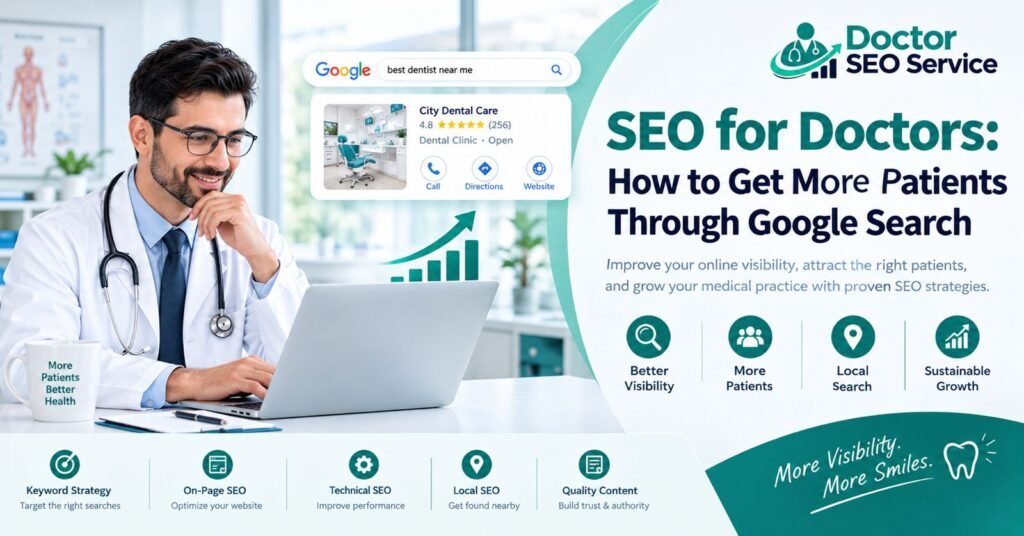
Introduction: How Can Doctors Get More Patients Through Google?
When people need a doctor, specialist, or medical clinic, many begin by searching online. They may look for a cardiologist nearby, compare dermatologists, search for a dentist accepting appointments, or read about a hospital’s services before deciding whom to contact.
If your medical practice does not appear prominently in relevant search results, potential patients may discover competing providers instead.
SEO for doctors helps improve a medical practice’s visibility in search engines by optimizing its website, local business presence, service pages, and useful healthcare content. The goal is to help people find accurate information about your practice when they search for relevant services.
However, effective healthcare SEO is not simply about adding keywords to a website. It involves technical performance, useful content, local search optimization, trustworthy business information, and a convenient patient experience.
In this guide, you’ll learn how doctors and healthcare organizations can use SEO to improve online visibility, attract more relevant visitors, and turn website visits into appointment enquiries—without relying on unrealistic ranking promises.
What Is SEO for Doctors?
SEO for doctors is the process of improving a doctor’s or medical practice’s online presence so that relevant pages can be discovered, understood, and potentially ranked by search engines.
It includes several connected activities:
- Website SEO: Improving page titles, headings, content, internal links, and website structure.
- Local SEO: Helping people find a practice through location-based searches and Google Maps.
- Technical SEO: Making the website accessible to search crawlers and improving performance.
- Medical content development: Publishing accurate, helpful information about specialties, services, procedures, and common patient questions.
- Reputation management: Maintaining accurate business information and responding professionally to patient feedback.
- Conversion optimization: Making it easier for visitors to call, request an appointment, or find clinic information.
For example, a dermatologist in Delhi might want to reach people searching for “dermatologist in South Delhi,” “acne treatment consultation,” or “skin specialist near me.” A well-structured website with relevant service pages and accurate local business information can help search engines understand which searches are relevant to that practice.
SEO cannot guarantee a particular ranking or a specific number of new patients. Results depend on competition, location, website quality, reputation, search demand, and many other factors.
1. Start With the Right Healthcare Keyword Strategy
Keyword research helps you understand the language people use when looking for medical services. Instead of targeting only broad phrases such as “doctor” or “hospital,” organize keywords around specialties, services, locations, and patient needs.
Target specialty-specific keywords
Build your keyword strategy around the actual services your practice provides.
Examples include:
- Cardiologist in Delhi
- Orthopedic doctor in Gurgaon
- Dermatologist for acne treatment
- Dental implant clinic in New Delhi
- IVF clinic consultation
- Physiotherapy clinic near me
- Eye specialist for vision problems
Use these phrases naturally where they are relevant. Do not create pages for specialties or treatments your practice does not provide.
Include location-based searches
For clinics serving a defined geographic area, local search intent is particularly important.
Consider a physiotherapy practice in Gurgaon. Relevant searches might include:
- Physiotherapist in Gurgaon
- Physiotherapy clinic in Sector 43
- Sports injury physiotherapy in Gurgaon
- Back pain physiotherapy consultation
The location should match your genuine service area. Avoid creating misleading pages that suggest your clinic has a physical branch where it does not operate.
Understand search intent
Not every person searching for a medical term is ready to book an appointment.
A search such as “what does high blood pressure mean?” is primarily informational. Someone searching for “cardiologist appointment in Delhi” may have stronger intent to contact a provider.
Create content for both audiences:
- Informational pages: Explain medical concepts, symptoms, preparation, and general treatment options with appropriate clinical review.
- Service pages: Describe the services your practice offers, the relevant specialist, appointment process, and how patients can contact you.
- Location pages: Explain where a genuine clinic is located, which services are available there, and how patients can reach it.
This approach builds a useful website instead of forcing every visitor toward an appointment before answering their question.
2. Build Dedicated, Helpful Pages for Your Medical Services
One of the most important parts of medical SEO is having clear pages for your actual specialties and services.
A website that lists every treatment in one short paragraph may give search engines and patients too little information to understand what the practice offers.
For example, a multispecialty clinic could have dedicated pages for cardiology, dermatology, orthopedics, dentistry, and physiotherapy—provided those services are genuinely available.
What should a doctor’s service page include?
A useful service page should answer the questions a potential patient is likely to have:
- What service or specialty does the practice provide?
- Which qualified professional provides the service?
- What types of concerns or conditions does the service address?
- What can a patient expect during an appointment?
- Where is the clinic located, and when is it open?
- How can someone request an appointment?
- What are the limitations, risks, or important considerations that patients should understand?
Clinical information should be accurate, current, and reviewed by an appropriately qualified professional where necessary.
Avoid repeating the same generic copy across multiple specialty pages. Explain the actual services, expertise, facilities, and patient processes that distinguish your practice.
Optimize page titles and headings
Use a clear, descriptive title for every important page.
For example:
Page title: Cardiologist in Gurgaon | Cardiology Consultations
H1 heading: Cardiologist in Gurgaon for Heart Health Consultations
Supporting headings could cover the specialist’s qualifications, services offered, appointment process, clinic location, and frequently asked questions.
Include relevant keywords naturally. Repeating “best cardiologist in Gurgaon” excessively does not make a page more useful and can harm the reading experience.
3. Improve Your Google Business Profile for Local SEO
For a medical practice that serves patients in a particular location, local SEO can be a major part of its online visibility strategy.
A complete and accurate Google Business Profile helps eligible businesses present information such as their name, address, phone number, hours, website, and services on Google Search and Maps.
Essential local SEO actions
Verify your business information. Use your real practice name and accurate contact details. Keep opening hours and appointment information current.
Choose relevant categories. Select the most appropriate primary category for your actual practice, then add relevant secondary categories where available and accurate.
Add services. Describe the specialties and services you genuinely provide. Make sure the information matches your website.
Upload authentic photos. Use appropriate images of your clinic, reception, facilities, and team, subject to patient privacy and consent requirements.
Maintain accurate contact details. Your website, business profile, and other reputable listings should show consistent information.
Encourage honest reviews. You may invite patients to share genuine feedback without pressure, incentives, or attempts to influence the content of their reviews. Respond professionally and never disclose private patient information in a public response.
Example: A dental clinic in Gurgaon
Imagine a dental clinic serving patients in Sushant Lok, Gurgaon. Its local SEO strategy could include:
- A complete and verified business profile.
- A dedicated website page describing its genuine Gurgaon location.
- Clear information about preventive dentistry, restorative services, and consultations.
- Consistent opening hours and contact details.
- A straightforward appointment request process.
- Useful content answering common questions about dental visits.
These actions help users understand the practice and can support local discoverability. However, Google Maps visibility varies by search relevance, distance, prominence, and other factors; no business can guarantee the top position for every nearby search.
4. Create Useful, Trustworthy Medical Content
Healthcare content requires special care because readers may use it when making decisions about their health.
Google’s guidance emphasizes helpful, reliable, people-first content. For medical websites, demonstrating appropriate expertise and trustworthiness is particularly important.
Choose topics that answer real patient questions
Your content calendar can include topics related to the services you provide, such as:
- What to expect during a first cardiology consultation
- Questions to ask before choosing a dental implant provider
- How to prepare for a dermatology appointment
- What happens during a physiotherapy assessment?
- What information should patients bring to an eye examination?
These topics can help prospective patients understand the consultation process and decide whether to contact your practice.
Use qualified medical reviewers
When an article includes clinical advice, diagnosis-related information, treatment options, medication information, or medical risks, identify the author and include a qualified medical reviewer where appropriate.
A strong medical article should:
- Use reputable, authoritative sources.
- Distinguish general educational information from individualized medical advice.
- Avoid exaggerated treatment claims.
- Explain important limitations and risks.
- Include a publication or review date when useful.
- Be updated when recommendations or evidence change.
Do not invent credentials, patient stories, success rates, or testimonials. If you publish professional biographies, ensure qualifications and experience are accurate and verifiable.
Make content genuinely useful
A page should provide meaningful information rather than merely repeat search phrases. Explain what a service involves, what patients should expect, and how to contact the practice for further information.
Useful content can support both search visibility and patient confidence. It does not, by itself, guarantee a higher ranking.
5. Improve Technical SEO and Website Performance
Even excellent content can struggle to perform if search engines cannot reliably access the website or visitors encounter a frustrating experience.
Technical SEO helps search engines discover, crawl, and understand your site’s pages.
Check these technical SEO essentials
Indexability: Make sure important public pages are not accidentally blocked by robots directives or marked noindex.
XML sitemap: Maintain an accurate sitemap that includes the canonical pages you want search engines to discover.
HTTPS security: Serve your website securely using HTTPS.
Mobile usability: Ensure pages, menus, forms, phone links, and appointment buttons work properly on mobile devices.
Page speed: Optimize image sizes, reduce unnecessary scripts, use caching appropriately, and review performance on real pages.
Broken links: Repair important internal links that lead to missing pages.
Canonical URLs: Use consistent canonical URLs to help identify the preferred version of duplicate or similar pages.
Structured data: Add relevant structured data when it accurately describes visible page content and follows search engine guidelines.
Use structured data appropriately
Depending on your website and the content of a page, relevant schema types may include Organization, Person, Article, or BreadcrumbList. Local business or medical-related markup should be selected carefully and used only when the information meets the relevant schema definition.
Structured data can help search engines interpret information, but valid markup does not guarantee rich results, higher rankings, or citations in AI-generated answers.
Check your implementation with Google’s Rich Results Test where applicable and use Schema.org’s documentation to validate the chosen vocabulary.
6. Strengthen Your Website With Internal Links
Internal links connect related pages on your website. They help users navigate your services and help search engines discover relationships between pages.
For example, a blog article about choosing a dermatologist could link naturally to your dermatology SEO service page, a relevant specialty page, or an article about preparing for a consultation.
For Doctor SEO Service, consider connecting this article with relevant service pages such as:
- Doctor SEO Service homepage
- Healthcare SEO services — use the final, dedicated healthcare SEO landing page URL if it differs from the homepage.
- Related articles about dental SEO, healthcare website development, and AI search optimization, once their published URLs are confirmed.
Use descriptive anchor text that tells readers what they can expect after clicking. Avoid forcing links into unrelated sentences or using the same keyword-heavy anchor text everywhere.
Before publishing, verify every internal link and replace provisional destinations with the exact live page URL.
7. Build Trust Through Ethical Reputation and Authority Signals
Patients often consider qualifications, experience, location, reviews, and the clarity of a practice’s information when evaluating a healthcare provider.
Your website should make legitimate trust signals easy to find.
Depending on the practice, these may include:
- Accurate clinician names and professional qualifications.
- Relevant specialty training and verifiable credentials.
- Clear clinic address and contact information.
- Genuine photographs of the premises and team.
- Transparent information about services and appointment procedures.
- Patient reviews displayed and managed in accordance with applicable rules.
- Author and medical reviewer details on educational articles.
- References to reliable clinical sources where medical claims are made.
External mentions and links from reputable, relevant websites can also support a website’s authority over time. Prioritize genuine professional associations, healthcare publications, useful partnerships, and original resources rather than purchasing large quantities of low-quality backlinks.
Do not publish misleading claims such as guaranteed results, unsupported “number one” rankings, or unverified treatment success rates.
8. Optimize for AI Search Without Neglecting SEO Fundamentals
Patients increasingly encounter summaries and recommendations through AI-powered search experiences. Healthcare businesses may therefore want their information to be clear, accessible, and easy for search systems to interpret.
The fundamentals remain important: create useful content, maintain accurate business information, make pages accessible to crawlers, and explain who provides each service.
Practical steps for AI search readiness
Answer questions directly. Begin relevant sections with concise, accurate answers before adding context.
Use clear headings. Organize information around meaningful questions and topics.
Identify people and organizations accurately. Keep clinician names, qualifications, practice details, and author information consistent across the website.
Publish original expertise. Include real service details and qualified perspectives rather than generic, repetitive text.
Keep important content accessible. Do not hide essential information exclusively inside images, inaccessible widgets, or scripts that prevent users or crawlers from accessing it.
Use structured data accurately. Make sure schema matches the visible page and represents genuine facts.
Maintain technical SEO. Ensure that important pages can be crawled and indexed where intended.
There is no reliable method to guarantee that a particular page will be cited by an AI system. AI platforms use different retrieval and selection processes, and their behavior can change. Treat AI search optimization as an extension of a sound content and technical strategy—not a replacement for it.
9. Turn Search Visitors Into Appointment Enquiries
Traffic alone does not tell you whether SEO is helping your practice. A useful website should make the next step clear and convenient.
Improve the patient journey
Consider these improvements:
- Display a clear “Book an Appointment” or “Request a Consultation” button.
- Make the clinic phone number easy to tap on mobile devices.
- Explain how appointments are requested and what happens next.
- Display accurate opening hours and location information.
- Keep enquiry forms short and accessible.
- Provide clear privacy information before collecting personal details.
- Avoid asking visitors to submit unnecessary sensitive health information through ordinary marketing forms.
Make sure the appointment process works from the pages that receive the most organic traffic. Test forms, phone links, confirmation messages, and mobile layouts regularly.
Measure meaningful conversions
Use tools such as Google Search Console and an appropriately configured analytics platform to evaluate performance.
Track indicators such as:
- Organic clicks and impressions.
- Search queries that lead users to relevant pages.
- Search visibility for priority specialties and locations.
- Appointment form submissions.
- Clicks on phone numbers and appointment buttons.
- Qualified enquiries and, where you can measure it responsibly, booked appointments.
Configure conversion tracking with privacy in mind. Avoid sending patient names, contact details, medical conditions, or other sensitive health information to analytics platforms through URLs, event labels, or other tracking parameters. Follow applicable privacy and healthcare requirements in the markets you serve.
Review results over time rather than judging success from a single keyword position or short reporting period.
10. How Long Does SEO for Doctors Take?
SEO is a long-term process, and timelines vary. A new website in a competitive city may need more time to build visibility than an established practice with a technically sound website and useful content.
Progress can depend on:
- Website history and technical condition.
- Competition in the specialty and location.
- Quality and relevance of the website’s content.
- Local business information and reputation.
- Search demand and changes in search behavior.
- The resources available to implement improvements consistently.
Early work may focus on fixing technical issues, improving service pages, and correcting business information. Over time, content development, local optimization, and ongoing performance reviews can help identify opportunities for further improvement.
Be cautious of agencies promising guaranteed first-page rankings or a fixed number of patients within a short period. A responsible SEO provider should explain the work being performed, the metrics being monitored, and the factors that may affect results.
Frequently Asked Questions About SEO for Doctors
1. What is SEO for doctors?
SEO for doctors improves the discoverability of a doctor’s or medical practice’s website in relevant search results. It can include on-page SEO, technical improvements, local SEO, useful medical content, and website conversion optimization.
2. Why is local SEO important for doctors?
Local SEO helps people discover relevant healthcare providers when searching for services in a particular area. Accurate business information, a well-maintained Google Business Profile, and useful location-specific website content can support local visibility.
3. Can SEO help a new medical practice attract patients?
Yes, SEO can help a new practice become discoverable online, but results are not guaranteed. A new practice should establish accurate business information, create helpful service pages, ensure its website is technically accessible, and develop a consistent content and local SEO strategy.
4. Should every medical specialty have its own page?
A dedicated page is often useful when the practice genuinely offers a distinct specialty or service and can provide meaningful information about it. Avoid creating thin, repetitive pages for every possible keyword or location.
5. How often should doctors publish blog content?
There is no universal publishing frequency that guarantees rankings. Prioritize accuracy, usefulness, and appropriate clinical review. A realistic schedule of well-researched articles is generally more valuable than publishing large volumes of low-quality content.
6. Do Google reviews improve a doctor’s ranking?
Reviews can contribute to a business’s online reputation and may be relevant to local search prominence. However, rankings depend on multiple factors, and reviews do not guarantee a particular position. Encourage honest feedback and protect patient confidentiality when responding.
7. Can an SEO agency guarantee that my clinic will rank first on Google?
No responsible agency can guarantee a first-place ranking for every search. Search results vary by query, location, competition, and other factors. Choose a provider that explains its strategy and reports meaningful progress transparently.
8. Is SEO useful for doctors who already receive patient referrals?
It can be. SEO may help people who receive a referral verify the practice, review its services, find directions, or request an appointment. It can also improve discoverability among people searching for relevant services independently.
9. Does AI search optimization replace traditional SEO?
No. Useful content, accessible pages, accurate information, and sound technical SEO remain important. AI search optimization adds attention to clarity, entity information, structured data, and how content answers questions, but no approach guarantees AI citations.
10. How can I start SEO for my medical practice?
Start by reviewing your website’s technical health, service pages, local business information, and search performance. Then prioritize the improvements most relevant to your specialty, location, and patient journey.
Conclusion: Build a Stronger Online Presence for Your Medical Practice
SEO for doctors is about more than rankings. It helps people find relevant healthcare information, understand the services a practice provides, and take the next step when they are ready to contact a provider.
A sustainable strategy combines keyword research, useful specialty pages, local SEO, technical website improvements, trustworthy medical content, ethical reputation management, and clear appointment pathways.
Results take time and vary by practice. Focus on accurate information, a better user experience, and measurable improvements rather than guaranteed rankings or unsupported patient-growth claims.
Want to Improve Your Healthcare Website’s Search Visibility?
Doctor SEO Service helps healthcare businesses improve their online presence through healthcare SEO strategy, website optimization, content planning, and local search improvements.
Explore Doctor SEO Service to learn more and identify opportunities to strengthen your website’s visibility and patient enquiry journey.