How to Improve Visibility for Cosmetic Surgery Services
Introduction: How Can Cosmetic Surgeons Improve Online Visibility? People considering cosmetic surgery often research procedures, compare qualified surgeons, review clinic websites, and explore consultation options before contacting a provider. If a cosmetic surgery practice is…

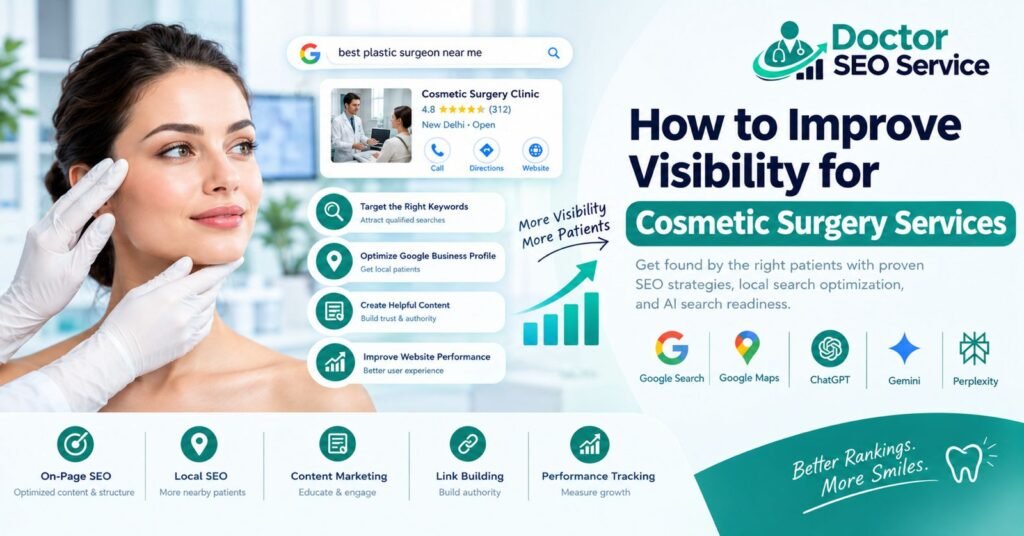
Introduction: How Can Cosmetic Surgeons Improve Online Visibility?
People considering cosmetic surgery often research procedures, compare qualified surgeons, review clinic websites, and explore consultation options before contacting a provider. If a cosmetic surgery practice is difficult to find on Google, potential patients may discover other clinics first.
To improve visibility for cosmetic surgery services, clinics should combine search engine optimization (SEO), local search optimization, informative website content, technical improvements, and trustworthy professional information. They should also make it easy for prospective patients to understand the services offered and request a consultation.
Effective cosmetic surgery SEO is not simply about ranking for popular keywords. It is about reaching people searching for relevant services, answering their questions responsibly, and providing accurate information that helps them make informed decisions.
In this guide, we explain practical ways cosmetic surgeons and plastic surgery clinics can improve their search visibility, strengthen their online presence, and generate more relevant consultation enquiries through Google and AI-powered search experiences.
What Is SEO for Cosmetic Surgery Services?
SEO for cosmetic surgery services is the process of improving a clinic’s website and online presence so search engines can discover, understand, and potentially rank its pages for relevant searches.
A cosmetic surgery SEO strategy typically includes:
- Keyword research: Identifying relevant procedure, specialty, and location-based searches.
- On-page SEO: Improving page titles, headings, service descriptions, and internal links.
- Local SEO: Helping nearby patients discover an eligible practice through local search results and Google Maps.
- Technical SEO: Improving crawlability, indexability, mobile usability, and website performance.
- Content marketing: Publishing accurate, useful information about procedures, consultations, recovery considerations, and patient questions.
- Trust and reputation management: Maintaining accurate professional information and encouraging genuine patient feedback ethically.
- Conversion optimization: Making consultation requests and clinic contact details easy to find.
These activities work together. A technically sound website with useful content and accurate business information provides a stronger foundation than a site focused only on repeating keywords.
1. Research Keywords That Match Cosmetic Surgery Search Intent
Keyword research helps a clinic understand what prospective patients search for and what information they need.
Instead of targeting only broad terms such as “cosmetic surgery,” organize keywords by procedure, specialty, location, and intent.
Target procedure-specific keywords
Depending on the services genuinely offered by the practice, relevant topics might include:
- Rhinoplasty consultation
- Facelift surgery consultation
- Eyelid surgery specialist
- Breast augmentation consultation
- Liposuction consultation
- Tummy tuck surgery
- Gynecomastia surgery consultation
- Cosmetic surgeon for facial procedures
- Plastic surgeon consultation
Use terminology that accurately describes the surgeon’s qualifications and services. Cosmetic surgery and plastic surgery overlap, but they are not interchangeable in every context. The content should reflect the professional’s actual specialty and scope of practice.
Include location-based keywords
Patients often search for healthcare services in a specific city or neighborhood.
Examples include:
- Cosmetic surgeon in New Delhi
- Plastic surgeon in Gurgaon
- Rhinoplasty consultation in Delhi
- Cosmetic surgery clinic near me
Use location keywords only where the practice genuinely serves those areas. Do not create misleading location pages that suggest the clinic has an office or branch where it does not operate.
Understand the searcher’s intent
Different searches require different pages.
Someone searching for “what happens during rhinoplasty recovery?” may want educational information. Someone searching for “rhinoplasty consultation in Delhi” may be looking for a qualified provider.
Create content that serves both needs:
- Informational content: Explains procedures, consultation preparation, risks, recovery considerations, and questions to discuss with a surgeon.
- Service pages: Describe the procedure, the qualified professional providing it, and the consultation process.
- Location pages: Provide genuine clinic location information, contact details, and available services.
Avoid treating every visitor as a ready-to-book patient. Useful educational content can help people understand their options before they decide whether to contact a clinic.
2. Create Dedicated, High-Quality Pages for Each Service
A cosmetic surgery clinic should make its services easy to understand through clear, well-organized website pages.
If a clinic offers several procedures, one generic page listing every service may not adequately answer visitors’ questions. Dedicated pages can explain the individual procedure and the consultation process in greater detail.
What should a cosmetic surgery service page include?
A useful service page can cover:
- Procedure overview: Explain the service in clear, accessible language.
- Professional qualifications: Identify the surgeon and provide accurate, verifiable credentials.
- Consultation process: Explain what prospective patients can expect when discussing the procedure.
- Potential benefits and limitations: Present balanced information without guaranteeing outcomes.
- Risks and recovery: Discuss relevant considerations with appropriate clinical review.
- Suitability: Explain that an individual assessment is necessary and that not every procedure is appropriate for every person.
- Frequently asked questions: Address common questions with accurate, qualified input.
- Contact options: Make it easy to request a consultation or contact the clinic.
Avoid promising specific results or presenting cosmetic surgery as risk-free. Clinical claims should be supported by reliable sources and reviewed by an appropriately qualified professional when necessary.
Optimize titles and headings naturally
For example:
SEO title: Rhinoplasty Consultation in Delhi | [Clinic Name]
H1 heading: Rhinoplasty Consultations With a Qualified Surgeon in Delhi
Supporting headings might explain the consultation process, what questions to ask, important considerations, and how to contact the clinic.
Use descriptive headings and natural language. Repeating phrases such as “best cosmetic surgeon” throughout a page does not replace useful information or establish professional quality.
3. Improve Local SEO for Cosmetic Surgery Clinics
Local SEO helps people discover relevant businesses and healthcare providers when searching for services in a particular area.
For clinics with a physical location, an accurate and well-maintained Google Business Profile can support local discoverability.
Practical local SEO steps
Complete your business information. Maintain the correct clinic name, address, phone number, website, and opening hours.
Choose accurate business categories. Select the most appropriate available category for the real business and its services.
Keep services updated. List services that the clinic genuinely offers and ensure the information agrees with the website.
Add authentic photographs. Use appropriate photos of the premises and team. Obtain consent before using identifiable patient images.
Maintain consistent business details. Keep contact information consistent across your website and reputable directories.
Encourage genuine reviews. Invite patients to leave honest feedback without pressure, incentives, or attempts to control what they write. Respond professionally without disclosing confidential patient information.
Example: A cosmetic surgery clinic in Delhi
A clinic serving patients in Delhi could create a useful local SEO foundation by maintaining an accurate Google Business Profile, publishing a dedicated page for its genuine clinic location, explaining its consultation process, and making its contact information easy to find.
It could also publish educational articles about choosing a qualified surgeon and preparing questions for an initial consultation.
These steps can improve the clarity and completeness of the clinic’s online presence. However, local rankings depend on factors such as relevance, distance, prominence, and competition. No clinic can guarantee the top position for every local search.
4. Publish Helpful Content That Builds Trust
Cosmetic surgery is a significant personal and medical decision. People need reliable information about procedures, qualifications, potential risks, and consultation options.
A content strategy should prioritize patient understanding rather than publishing articles solely to target keywords.
Useful cosmetic surgery blog topics
Depending on the clinic’s actual specialties, possible topics include:
- Questions to ask during a cosmetic surgery consultation
- How to evaluate a plastic surgeon’s qualifications
- What to discuss before considering rhinoplasty
- Understanding the consultation process for a facelift
- Questions about recovery after a cosmetic procedure
- How to compare cosmetic surgery clinics responsibly
- Why individual assessments matter before surgery
Clinical content should be checked against authoritative medical sources and reviewed by an appropriately qualified clinician where needed.
Demonstrate experience and expertise accurately
Trustworthy healthcare content should identify its author and, where appropriate, its medical reviewer. Include real professional qualifications and verifiable experience.
Useful quality signals include:
- Accurate surgeon biographies and credentials.
- Clear explanations of the services offered.
- References to reputable medical organizations.
- Publication and review dates where relevant.
- Balanced information about benefits, limitations, and risks.
- Clear contact details and clinic policies.
- Genuine photographs and patient testimonials used with proper consent.
Do not invent case studies, credentials, success rates, or patient testimonials. Before-and-after photographs should be authentic, appropriately consented, and presented without misleading editing or implications that every patient will achieve the same outcome.
5. Improve Technical SEO and Website Experience
A cosmetic surgery website needs more than attractive design. Search engines must be able to access important pages, and visitors should be able to navigate the site easily.
Technical SEO checklist
Crawlability and indexing: Confirm that important public pages are accessible to search engines and are not accidentally blocked or marked noindex.
XML sitemap: Maintain an accurate sitemap that includes the canonical pages you want search engines to discover.
HTTPS: Secure the website with HTTPS.
Mobile usability: Test service pages, menus, contact forms, and appointment buttons on mobile devices.
Page performance: Optimize large images, reduce unnecessary scripts, and review loading performance.
Internal links: Connect related procedure pages, educational articles, surgeon biographies, and contact pages.
Broken links: Fix important links that lead to missing pages.
Canonical URLs: Specify preferred URLs where duplicate or substantially similar pages could cause confusion.
Accessible content: Ensure that important information is available as readable text rather than being embedded only in images.
Optimize images responsibly
Cosmetic surgery websites often use professional portraits, clinic photographs, and procedure-related illustrations. These should be optimized for performance without compromising accuracy or consent.
Use descriptive filenames and meaningful alt text. For example:
cosmetic-surgery-consultation-clinic.jpg
Possible alt text:
“Patient discussing cosmetic surgery options with a qualified surgeon during a consultation.”
Alt text should describe the actual image rather than repeat a list of target keywords.
6. Strengthen Internal Linking and Website Structure
Internal links help visitors discover related information and help search engines understand the relationships between pages.
For example, a blog post about choosing a cosmetic surgeon could link to the clinic’s relevant procedure pages, surgeon biography, consultation page, and educational articles.
For Doctor SEO Service, relevant resources include the Plastic Surgery SEO Services page, the main SEO Services page, the homepage, and the Free SEO Audit page.
Use descriptive anchor text and link only where the destination is relevant to the sentence. Avoid creating excessive links or sending every visitor to the same generic page.
A sensible content structure might look like this:
- Plastic surgery SEO service page
- Cosmetic surgery SEO guidance
- Procedure-specific content strategy
- Local SEO for plastic surgeons
- Healthcare website optimization
- AI search optimization for medical websites
Only publish pages that provide distinct value. Do not generate near-identical pages for multiple locations or procedures simply to capture additional keywords.
7. Build a Responsible Online Reputation
Reputation can influence whether prospective patients decide to explore a clinic or request a consultation.
A trustworthy online presence should provide accurate, verifiable information about the practice and its professionals.
Consider these actions:
- Keep surgeon biographies and qualifications current.
- Explain the clinic’s services and consultation process clearly.
- Provide accurate location and contact details.
- Invite genuine patient feedback without manipulation.
- Respond professionally to reviews.
- Protect patient privacy in all public communications.
- Seek relevant professional mentions and links through legitimate relationships and useful resources.
External links from reputable, relevant websites can support a website’s authority over time, but quality matters more than quantity. Avoid purchasing large volumes of low-quality backlinks or participating in deceptive link schemes.
Trust cannot be manufactured by adding badges or unsupported claims. It should be reflected in accurate information, transparent communication, and responsible healthcare marketing.
8. Prepare Your Website for AI Search and Generative Search Experiences
AI-powered search experiences may summarize information from multiple sources to answer users’ questions. Cosmetic surgery practices can prepare by making their content clear, accurate, accessible, and easy to interpret.
Practical GEO and AI search recommendations
Answer questions directly. Start relevant sections with concise answers, then provide the supporting explanation.
Use descriptive headings. Organize information into meaningful sections about procedures, qualifications, consultation steps, and patient questions.
Identify entities accurately. Keep surgeon names, professional credentials, clinic names, locations, and author details consistent.
Publish original expertise. Use genuine information about the clinic and its services rather than generic content copied across many pages.
Maintain technical accessibility. Ensure important public pages can be discovered and accessed by the relevant crawlers, subject to your site’s access settings and applicable policies.
Use appropriate structured data. Mark up content accurately where relevant, ensuring that the markup matches visible page information.
Maintain traditional SEO fundamentals. Useful content, crawlable pages, sound technical implementation, and accurate business information remain important.
Structured data may help search engines interpret page information, but it does not guarantee enhanced search results or citations in AI-generated answers. Different AI platforms use different systems, and their selection processes can change. No agency can guarantee that a clinic will appear in every AI answer.
9. Use Structured Data Correctly
Structured data provides information about a page in a format that search engines can interpret.
Depending on the page, relevant schema types may include:
Organizationfor accurate organization details.Personfor a surgeon or article author where appropriate.ArticleorBlogPostingfor editorial content.BreadcrumbListfor page navigation.- Appropriate local business or medical-related types when the definition fits the real entity and available information.
Do not add ratings, credentials, locations, or other information that is not genuine. Markup should reflect the visible content and follow the relevant schema and search engine guidelines.
Validate eligible implementations with Google’s Rich Results Test and consult Schema.org documentation when selecting schema types.
Correct structured data helps clarify information, but it does not guarantee a ranking boost, a rich result, or an AI citation.
10. Measure SEO Performance and Consultation Enquiries
A successful SEO strategy should be evaluated through meaningful outcomes rather than keyword positions alone.
Use Google Search Console to monitor organic search impressions, clicks, queries, and page performance. Use a suitable analytics platform to understand how visitors interact with the website.
Useful metrics include:
- Organic clicks and impressions.
- Search visibility for relevant services and locations.
- Visits to important procedure pages.
- Appointment form submissions.
- Clicks on phone numbers and consultation buttons.
- Qualified enquiries and booked consultations, where measurement is available and appropriate.
- Engagement with important educational content.
Review performance over time. Rankings and traffic can fluctuate, so avoid making decisions based on a single day or isolated keyword.
Configure tracking responsibly. Do not send patient names, contact details, medical conditions, or other sensitive health information to analytics tools through URLs, event names, or tracking parameters. Follow the privacy requirements applicable to your clinic and the markets it serves.
Frequently Asked Questions
1. How can cosmetic surgeons improve visibility on Google?
Cosmetic surgeons can improve their online visibility by creating useful procedure pages, optimizing page titles and headings, maintaining accurate local business information, improving website performance, and publishing trustworthy content reviewed by qualified professionals where appropriate.
2. What is cosmetic surgery SEO?
Cosmetic surgery SEO is the process of improving a cosmetic surgery clinic’s website and online presence so relevant pages can be discovered and potentially ranked for searches related to its genuine services.
3. Is local SEO important for plastic surgeons?
Local SEO can be important for clinics that serve patients in a specific area. Accurate business information, a well-maintained Google Business Profile, and useful location-specific website content can help people discover the practice.
4. Should every cosmetic procedure have a separate page?
A separate page can be helpful when the clinic genuinely provides the procedure and can offer meaningful, accurate information about it. Avoid creating thin, repetitive pages that provide little value beyond changing the procedure name or location.
5. How long does cosmetic surgery SEO take to work?
Timelines vary depending on the website’s history, competition, location, content quality, technical condition, and implementation consistency. SEO is an ongoing process, and no fixed timeline or ranking position can be guaranteed.
6. Can blog content attract cosmetic surgery enquiries?
Helpful articles can reach people researching procedures and help them understand the consultation process. Relevant internal links and clear contact options can guide interested readers toward further information, although not every visitor will become an enquiry.
7. How can cosmetic surgery clinics prepare for AI search?
Clinics can publish clear and accurate content, identify qualified professionals correctly, maintain accessible pages, use appropriate structured data, and keep business information consistent. These practices support clarity but do not guarantee citations in AI-generated responses.
8. What should a cosmetic surgery SEO agency provide?
A responsible agency should explain its technical, on-page, local, and content strategy; establish measurable objectives; report work and performance transparently; and avoid guaranteed ranking claims or misleading healthcare marketing.
Conclusion: Build Long-Term Visibility for Cosmetic Surgery Services
Improving visibility for cosmetic surgery services requires a coordinated strategy that combines keyword research, helpful procedure pages, local SEO, technical performance, trustworthy professional information, and a convenient consultation journey.
Clinics should prioritize the questions prospective patients actually ask and provide accurate information that helps them evaluate their options responsibly. Strong website foundations can support discoverability across traditional search and emerging AI-powered experiences, but results depend on multiple factors and cannot be guaranteed.
Improve Your Cosmetic Surgery Website’s Search Visibility
Doctor SEO Service helps healthcare businesses strengthen their online presence through healthcare SEO strategy, website optimization, content planning, and local search improvements.
Explore our Plastic Surgery SEO Services to learn how a focused SEO strategy can help your clinic improve its website, reach relevant audiences, and measure meaningful enquiries.
You can also explore our broader SEO Services or request a Free SEO Audit to identify potential opportunities for your website.
Editorial note: This article provides marketing and search optimization guidance, not medical advice. Clinical information should be reviewed by a suitably qualified professional where appropriate.