How AI Search Systems Discover Website Content
AI search systems discover website content through a combination of web crawling, search indexes, retrieval systems, content interpretation, and, in some cases, real-time web browsing. Depending on the platform and search experience, an AI system…

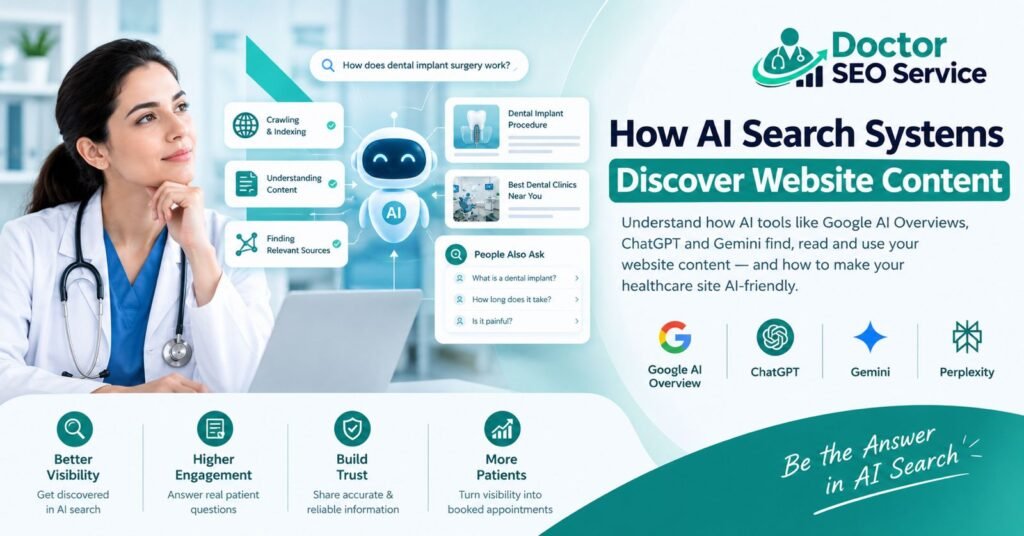
AI search systems discover website content through a combination of web crawling, search indexes, retrieval systems, content interpretation, and, in some cases, real-time web browsing. Depending on the platform and search experience, an AI system may use information from a search engine index, retrieve relevant web pages, process content supplied through connected sources, or combine several information sources to generate an answer.
For website owners, this means that publishing content alone is not enough. Important pages should be accessible to relevant crawlers, technically sound, clearly structured, accurate, and useful to the intended audience.
Understanding how AI search systems discover website content can help businesses improve their visibility across traditional search engines and AI-powered experiences, including Google AI Overviews, ChatGPT search, Gemini, and Perplexity.
In this guide, Doctor SEO Service explains how content discovery works, how AI systems interpret website information, which technical SEO practices matter, and how businesses can prepare their websites for evolving search technologies.
What Does It Mean for AI Search Systems to Discover Website Content?
AI search content discovery refers to the processes through which an AI-powered search experience obtains, retrieves, and interprets information from available sources.
These processes can include several distinct stages:
- Discovery: Finding URLs through links, sitemaps, or other discovery mechanisms.
- Crawling: Fetching accessible web pages using automated software.
- Indexing: Processing and storing information so that it can be retrieved later, where the platform uses an index.
- Retrieval: Identifying potentially relevant information in response to a query.
- Interpretation: Processing the retrieved content to understand its meaning and relevance.
- Answer generation: Producing a response based on the information available to the system.
- Source attribution: Providing links or citations when supported by the particular search experience.
These stages are related, but they are not identical. Not every AI system uses the same architecture, and not every system follows this exact sequence.
For example, a website may be indexed by a search engine but never cited in a particular AI-generated answer. Another system may access a page through a live browsing or retrieval process rather than relying exclusively on a traditional search index.
The key takeaway: Website owners should focus on making their content accessible, understandable, trustworthy, and relevant rather than assuming that one technical change will guarantee AI visibility.
How Do AI Search Systems Find Websites?
AI-powered search experiences can obtain information through several mechanisms.
1. Web Crawling
Web crawlers are automated programs that request and process web pages.
Search engines use crawlers to discover content, follow links, and collect information that may be used in their search indexes.
For example, a healthcare website might publish an article explaining dental implant treatment. A search crawler could discover the article through an internal link from the clinic’s dental implant service page.
If the crawler can access the page and the content is eligible for indexing, the search engine may process it for inclusion in its index.
Some AI services also operate dedicated crawlers for particular purposes, such as search discovery, training-related data collection, or user-requested browsing. Their purposes and controls differ.
Website owners should therefore identify which crawlers matter for their goals instead of treating all AI bots as interchangeable.
2. Search Engine Indexes
A search index is a structured collection of information about web pages that a search engine has processed.
When someone searches for a topic, the search engine can use its index to identify potentially relevant pages.
AI-powered search features may use information from a search engine’s index as part of their retrieval process.
For example, when someone searches for information about choosing a dentist, a search system may identify pages about dental services, professional qualifications, treatment considerations, and local clinics.
However, being indexed does not guarantee that a page will rank highly, appear in an AI-generated summary, or receive a citation.
3. Live Web Search and Retrieval
Some AI search experiences can retrieve information from the web while responding to a user’s question.
A system may issue search queries, identify relevant sources, access selected pages, and use information from those sources to formulate a response.
This can help the system use current information rather than relying only on information learned during earlier model training.
For example, someone asking about a clinic’s current opening hours may need recent business information rather than general information about dental care.
The exact retrieval process depends on the platform, query, and product configuration.
4. Links, Sitemaps, and Other Discovery Signals
Internal links help crawlers navigate your website and understand how pages relate to each other.
An XML sitemap can provide search engines with information about important URLs on your website.
External links may also lead crawlers to discover your content.
These mechanisms support discovery, but they do not guarantee crawling, indexing, rankings, or AI citations.
A well-organized website makes important information easier to locate and reduces unnecessary complexity for both users and automated systems.
How Do AI Systems Understand Website Content?
Discovering a URL is only the beginning. A system must also process the available information to determine whether it is useful for a particular question.
1. Content Structure and Semantic Meaning
Clear headings, descriptive titles, and logically organized paragraphs help readers understand a page.
They also make the relationships between different sections easier for automated systems to interpret.
Consider these two examples.
Unclear heading:
“Our Services”
More descriptive heading:
“Dental Implant Treatment: Consultation, Planning, and Aftercare”
The second heading provides more context about the content that follows.
A well-structured page should use one clear primary heading, descriptive subheadings, concise paragraphs where appropriate, and meaningful internal links.
Avoid adding headings or keywords merely to manipulate search systems. Every section should help readers understand the topic.
2. Entities and Relationships
An entity is a distinct, identifiable subject, such as a person, organization, location, medical specialty, or treatment.
For a healthcare website, relevant entities may include:
- A dental clinic.
- A registered dentist.
- A particular dental specialty.
- A clinic’s physical location.
- A treatment or procedure.
- A professional organization.
Clear and consistent information helps establish relationships between these entities.
For example, a dentist’s profile might identify the practitioner’s name, qualifications, specialty, workplace, and professional experience.
The information should be accurate and supported by appropriate evidence.
Do not invent credentials, qualifications, awards, or professional affiliations to strengthen a website’s apparent authority.
3. Context and Search Intent
AI search systems may need to understand not only what a page discusses but also which question it answers.
A page explaining the general meaning of dental implants serves a different purpose from a clinic page describing its implant consultation service.
Consider these searches:
- What are dental implants?
- How long does dental implant treatment take?
- How do I choose a dental clinic near me?
- Which services does a particular dental clinic offer?
Each query requires a different type of information.
A useful content strategy creates pages around genuine user needs and connects related pages through relevant internal links.
Why Technical SEO Matters for AI Search Visibility
AI search optimization does not replace technical SEO. If important website content cannot be accessed or interpreted properly, its usefulness may be limited.
1. Check Crawlability and Indexability
Review your website for technical barriers that could prevent important pages from being discovered or indexed.
Check:
- Robots.txt directives.
- Page-level
noindexdirectives. - HTTP response codes.
- Canonical URLs.
- XML sitemap accuracy.
- Internal links.
- Redirect chains.
- Duplicate pages.
- Server accessibility.
For example, a clinic may publish a detailed service page but accidentally prevent indexing through a noindex directive.
Identifying and correcting that issue may be more valuable than publishing additional articles.
Remember that crawler access, search indexing, and AI product usage are separate considerations. A page being accessible to one crawler does not mean every other service can access or use it.
2. Make Important Content Available as Readable Text
Essential information should be available in a form that users and relevant crawlers can access.
Do not place all important service details exclusively inside images, videos, or interface elements that require unsupported interactions.
For example, a healthcare service page should provide readable information about the service, the clinic, relevant practitioner details, and contact options.
JavaScript-rendered content can be indexed in some circumstances, but important information should be implemented in a way that is accessible and reliably rendered.
3. Improve Website Performance and Mobile Usability
A slow or confusing website can frustrate visitors and make it harder for them to use your services.
Review mobile layouts, navigation, image sizes, page loading behavior, accessibility, and Core Web Vitals.
These improvements support a better user experience, although passing a particular performance threshold does not guarantee higher rankings or AI citations.
4. Maintain Accurate Canonical URLs and Sitemaps
Canonical tags help indicate the preferred URL for duplicate or substantially similar pages.
An XML sitemap helps search engines discover URLs that you consider important.
For a website with several healthcare services, a clean structure might look like this:
- Homepage.
- Healthcare SEO services.
- SEO for doctors.
- Dental SEO services.
- Healthcare website development.
- Educational articles about healthcare marketing and AI search.
Keep URLs descriptive and avoid creating unnecessary variations of the same page.
What Role Does Structured Data Play in AI Search?
Structured data is a standardized format that helps describe information on a webpage.
For example, appropriate schema markup may describe an organization, an article, a breadcrumb hierarchy, or an eligible healthcare business.
Common schema types include:
OrganizationArticleBlogPostingBreadcrumbList- An appropriate healthcare business type where applicable.
Structured data should match the visible content of the page and follow the relevant search engine guidelines.
For a healthcare SEO article, BlogPosting markup might describe the headline, author, publication date, modification date, and featured image.
Organization markup can describe the business using accurate information.
However, structured data should not be treated as a shortcut to AI visibility. Valid schema does not guarantee enhanced search results, inclusion in AI Overviews, or citations in conversational answers.
The purpose is to describe information accurately and consistently.
How to Optimize Website Content for Generative Engine Optimization (GEO)
Generative Engine Optimization, commonly called GEO, refers to approaches intended to improve how content is discovered, understood, and potentially represented in generative AI search experiences.
There is no universal GEO formula that guarantees visibility across every platform.
A practical approach builds on established SEO principles while paying attention to the way people ask questions and how AI search experiences present information.
1. Answer Important Questions Clearly
Start each article by addressing the main question.
For example, an article about AI search discovery should explain early that systems may use crawling, indexing, retrieval, and content interpretation to find and use information.
Follow that explanation with detailed guidance, examples, and relevant limitations.
Clear answers help readers understand the subject without searching through unrelated introductory material.
2. Use Descriptive Headings
Organize content around the questions and subtopics that matter to the intended audience.
For example, a guide to AI search visibility might include:
- How AI Search Systems Discover Websites.
- How Search Engines Index Content.
- Why Technical SEO Matters.
- How Structured Data Helps.
- How to Measure AI Search Visibility.
These headings provide a logical structure without requiring excessive keyword repetition.
3. Publish Original, Useful Information
Content should provide value beyond repeating information already available elsewhere.
Useful additions may include practical examples, original research, expert commentary, implementation checklists, or explanations based on real experience.
For healthcare topics, ensure clinical claims are accurate and reviewed by qualified professionals when appropriate.
Do not fabricate case studies, testimonials, medical statistics, or expert endorsements.
4. Make Author and Organization Information Clear
Accurate author information helps readers understand who created the content and what relevant expertise they bring.
For healthcare content, identify qualified reviewers when medical review has actually taken place.
Keep your organization’s name, website, contact information, and service descriptions consistent.
These practices support transparency, but no particular author format guarantees that an AI platform will recommend or cite a website.
5. Avoid Unsupported AI Optimization Claims
Be cautious of services that promise guaranteed AI citations through a specific schema, keyword density, special file, or proprietary trick.
No universal technique ensures that a page will be cited by every AI search system.
Instead, prioritize technical accessibility, accurate content, clear structure, relevant expertise, and a website that genuinely answers users’ questions.
Should You Use llms.txt for AI Search Optimization?
Some website owners create an llms.txt file to provide language-model-oriented guidance or a curated overview of website resources.
It is important to distinguish this proposal from established search engine crawling and indexing mechanisms.
An llms.txt file is not a universal requirement for AI search visibility, and there is no general guarantee that AI search platforms will use it.
If you choose to implement one, treat it as an optional experiment rather than a replacement for essential technical SEO.
Prioritize:
- A working website.
- Accessible and useful HTML content.
- Accurate robots.txt rules.
- A valid XML sitemap.
- Correct canonical tags.
- Clear internal links.
- Useful, well-maintained pages.
Similarly, robots.txt and platform-specific crawler controls should be configured according to your website’s goals and the relevant service documentation.
Do not assume that allowing one crawler automatically authorizes or enables every other AI service to use your content.
Practical Example: Improving AI Search Discoverability for a Dental Clinic
Imagine a dental clinic that wants to improve its visibility for searches about dental implants.
Its website has a homepage, a general services page, and a short paragraph mentioning implants.
The clinic wants to attract relevant enquiries and help prospective patients understand its services.
A practical optimization process could include the following steps.
Step 1: Create a useful dental implant service page.
Explain the service, consultation process, relevant considerations, practitioner information, and how patients can contact the clinic.
Ensure clinical statements receive appropriate professional review.
Step 2: Improve technical accessibility.
Confirm that the page returns the correct response, is accessible to relevant crawlers, and does not contain accidental indexing restrictions.
Step 3: Connect related content.
Link the implant page to relevant practitioner profiles, the clinic’s contact page, and educational articles that answer related questions.
Step 4: Add appropriate structured data.
Use accurate organization information and relevant article or breadcrumb markup where applicable.
Do not add unsupported claims or structured data that misrepresents the page.
Step 5: Measure performance.
Monitor indexing, organic search impressions, clicks, relevant enquiries, and other available performance indicators.
Where AI referral or citation information is available, monitor it separately and recognize that measurement capabilities vary across platforms.
This process improves the quality and accessibility of the clinic’s website without assuming that any one change guarantees AI-generated recommendations.
How to Measure AI Search Visibility
Measuring AI search performance can be more difficult than measuring conventional organic traffic because different platforms expose different data.
A practical measurement plan should combine established SEO metrics with any reliable AI-specific indicators available to your business.
| Metric | What It Measures |
|---|---|
| Organic clicks | Visits from organic search results |
| Search impressions | How often pages appear in eligible search results |
| Indexing status | Whether important URLs are indexed where applicable |
| Referral traffic | Visits arriving from identifiable external sources |
| Qualified enquiries | Relevant requests for your services |
| Conversion rate | The proportion of visitors completing a desired action |
| AI citations or mentions | Observed references in AI answers, where reliably measurable |
| Content performance | Which pages attract relevant traffic and engagement |
Google Search Console can help you evaluate conventional search performance.
Analytics tools can measure website sessions and conversions when configured appropriately.
For AI visibility, manual sampling of relevant queries may provide supplementary insights, but results can vary by query, time, location, account, and platform.
Do not interpret a small set of observations as a comprehensive measure of all AI-generated answers.
Common Mistakes to Avoid When Optimizing for AI Search
Website owners can waste time and resources by focusing on unsupported techniques rather than improving their actual content.
Avoid these common mistakes:
- Blocking useful crawlers unintentionally.
- Assuming every AI platform uses the same crawler.
- Publishing large quantities of low-value, repetitive content.
- Adding structured data that does not match visible content.
- Treating
llms.txtas a guaranteed ranking factor. - Stuffing keywords into headings and paragraphs.
- Publishing unverified medical claims.
- Creating fake reviews, credentials, or case studies.
- Ignoring technical SEO while focusing exclusively on AI.
- Expecting immediate rankings or guaranteed AI citations.
A better strategy emphasizes useful information, accessible pages, accurate business details, and continuous measurement.
Frequently Asked Questions
1. How do AI search systems discover website content?
Depending on the platform, AI search systems may use search engine indexes, web crawling, live web retrieval, and other information sources. They identify relevant information and may use it to generate responses. The exact process varies between services.
2. Does a website need to be indexed by Google to appear in AI search?
Not necessarily across every AI platform. Different systems may use different indexes, retrieval mechanisms, and sources. However, being discoverable and indexable by major search engines can support visibility in their search experiences. Indexing does not guarantee an AI citation.
3. Does AI search optimization replace traditional SEO?
No. Technical SEO, helpful content, internal linking, accessibility, and accurate information remain important foundations. AI search optimization builds on these practices rather than replacing them.
4. Does structured data help AI systems understand website content?
Structured data can describe information in a standardized format and help supported systems interpret particular page elements. Its usefulness depends on the implementation and platform. It does not guarantee inclusion in AI-generated answers.
5. Is llms.txt required for AI search visibility?
No universal requirement establishes that every website needs llms.txt to appear in AI search. It can be explored as an optional approach, but website owners should prioritize established technical SEO practices and consult relevant platform documentation.
6. How can I make my website more useful to AI search systems?
Create original, accurate content; use clear headings; maintain accessible pages; improve internal linking; provide reliable author and organization information; and implement appropriate structured data. Measure results without assuming any technique guarantees citations.
7. Can AI search systems use healthcare website content?
Healthcare information may be surfaced or used by AI-powered search experiences depending on the platform, the content, and applicable technical and policy requirements. Healthcare businesses should ensure that published medical information is accurate, appropriately reviewed, and presented responsibly.
8. How long does it take for AI search systems to discover new content?
There is no universal timeline. Discovery and processing depend on the platform, crawling behavior, page accessibility, indexing processes, and other factors. Submitting a sitemap or linking to a new page can support discovery but does not guarantee immediate processing.
Improve Your Website’s AI Search Readiness With Doctor SEO Service
AI-powered search is changing how people discover information, but the foundations of a useful website remain consistent: clear content, reliable information, technical accessibility, and a good user experience.
Businesses that want to improve discoverability should begin by checking whether important pages can be accessed, whether content answers genuine questions, and whether the website communicates its services accurately.
At Doctor SEO Service, we focus on healthcare SEO, website development, search visibility, and digital marketing strategies for doctors, clinics, and hospitals.
Whether you are improving an existing medical website or building a new content strategy, a structured approach to technical SEO, helpful content, and AI search readiness can help establish a stronger digital foundation.
Want to improve your healthcare website’s search visibility?
Visit Doctor SEO Service to explore healthcare SEO and digital marketing solutions.