How to Attract More Local Patients Online: 12 Effective Strategies for Doctors and Healthcare Clinics
Patients increasingly use the internet to find doctors, compare healthcare providers, research medical services, and locate clinics near their homes or workplaces. Before making an appointment, someone might search for a dentist near them, a…

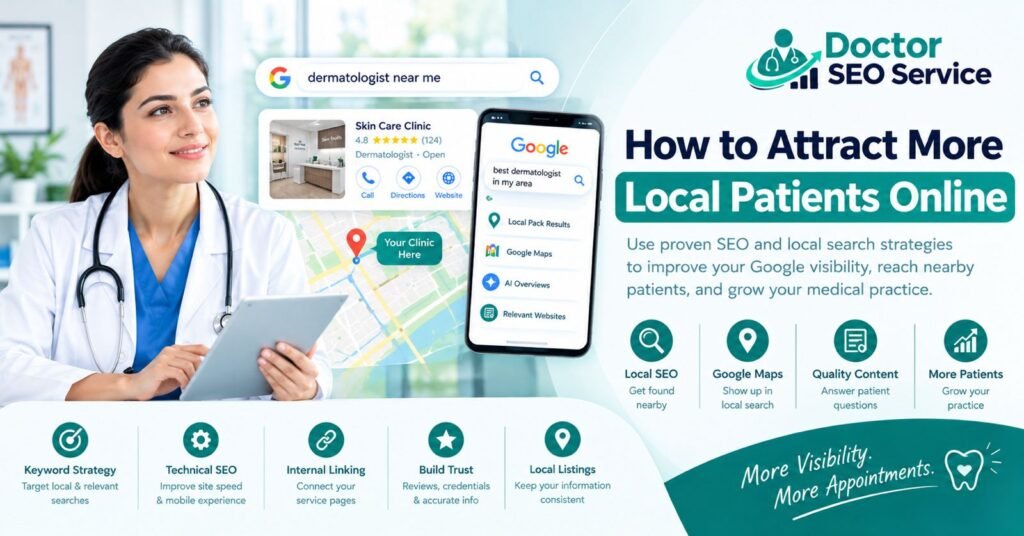
Patients increasingly use the internet to find doctors, compare healthcare providers, research medical services, and locate clinics near their homes or workplaces. Before making an appointment, someone might search for a dentist near them, a physiotherapist in their neighbourhood, an IVF centre in their city, or a specialist hospital offering a particular service.
For doctors and healthcare providers, this creates an important opportunity: a strong online presence can help connect your practice with people actively searching for healthcare services in your local area.
But simply creating a website or social media profile is not enough. To attract relevant local patients, your practice needs to be visible in search results, provide useful information, build trust, and make it easy for visitors to contact your clinic.
So, how can you attract more local patients online?
The most effective approach combines local search engine optimization (SEO), Google Business Profile management, healthcare website optimization, informative content, authentic patient reviews, social media marketing, and conversion-focused digital experiences.
In this guide, we explain 12 practical strategies that doctors, clinics, and hospitals can use to improve local visibility and generate relevant appointment enquiries.
1. Build a Professional Healthcare Website
Your website is often one of the first places prospective patients visit when researching your practice. It should clearly communicate who you are, what services you offer, where your clinic is located, and how patients can arrange an appointment.
A professional healthcare website is more than an online brochure. It acts as a central destination for your digital marketing activities.
Essential Pages Every Healthcare Website Should Have
Homepage: Introduce your clinic, medical specialties, location, and key services. Make the next step clear with prominent appointment and contact options.
About the Doctor or Clinic: Provide accurate information about the doctors, qualifications, professional experience, relevant registrations, and areas of practice.
Services Pages: Create dedicated pages for important services and specialties rather than placing every service into one generic section.
Location and Contact Page: Display the clinic’s address, phone number, opening hours, directions, and appointment information.
Blog or Resources Section: Publish helpful articles that answer common questions and explain healthcare services.
Appointment Page: Make it easy for visitors to call, submit an enquiry, or use an available booking system.
Make Your Website Mobile-Friendly
Many people search for healthcare providers using smartphones. Your website should therefore:
- Adapt to different screen sizes.
- Load efficiently on mobile connections.
- Display readable text and clear headings.
- Provide clickable phone numbers.
- Use visible appointment buttons.
- Keep forms short and easy to complete.
- Avoid intrusive pop-ups.
- Offer straightforward navigation.
For example, someone searching for a dentist near their office may want to call the clinic immediately. If the phone number is difficult to locate, that visitor may leave and contact another practice.
Practical tip: Test your website as if you were a first-time patient. Can you understand the clinic’s services, find its address, and request an appointment without confusion?
2. Optimize Your Google Business Profile for Local Visibility
Google Business Profile is an important tool for eligible healthcare practices with a physical location or qualifying service area.
When people search for local healthcare services, Google may show local business information alongside organic search results and Google Maps. A complete and accurate profile helps prospective patients discover essential details about your practice.
How to Optimize Your Google Business Profile
Use your real business name. Keep the profile name consistent with your clinic’s actual business identity. Do not add unnecessary keywords to manipulate local rankings.
Choose the most appropriate category. Select the category that accurately represents your healthcare practice. Add relevant secondary categories only when they genuinely apply.
Verify your address and contact details. Check that your clinic address, phone number, website, and opening hours are correct.
Add genuine clinic photographs. Upload suitable photographs of your reception, consultation rooms, exterior, and facilities. Obtain appropriate permission before publishing identifiable patient or staff photographs.
Describe your services accurately. Include the treatments and services genuinely offered by your clinic.
Keep business hours updated. Update holiday schedules, temporary closures, and changes in availability.
Manage patient feedback professionally. Encourage honest reviews without offering incentives or pressuring patients to leave positive feedback.
Google’s Business Profile guidelines explain how businesses should represent themselves accurately.
Why Google Maps Visibility Matters
Consider someone searching for “physiotherapist near me” or “dental clinic in Gurgaon.” A relevant local result can help that person discover your clinic, check its location, review available information, and visit your website.
However, completing your profile does not guarantee a top Google Maps position. Local visibility depends on several factors, including relevance, distance, and prominence.
3. Invest in Local SEO for Doctors and Healthcare Providers
Local SEO helps improve your online visibility for searches associated with a specific geographic area.
For healthcare providers, this is especially useful because patients often prefer clinics that are conveniently located and offer the services they need.
Target Location-Specific Keywords
Instead of targeting only broad terms such as “doctor” or “clinic,” develop a keyword strategy around your specialty and service locations.
Examples include:
| Healthcare specialty | Local keyword examples |
|---|---|
| Dentist | Dentist in [City], dental clinic near me |
| Physiotherapist | Physiotherapist in [Location], physical therapy clinic |
| IVF centre | IVF centre in [City], fertility clinic near me |
| Plastic surgeon | Plastic surgeon in [Location], cosmetic surgery consultation |
| Cardiologist | Cardiologist in [City], heart specialist near me |
| Dermatologist | Dermatologist in [Location], skin specialist near me |
| Orthopedic doctor | Orthopedic clinic in [City], bone specialist near me |
Use these phrases naturally in relevant page titles, headings, service descriptions, and website content.
Avoid repeating the same keyword unnaturally throughout every page.
Create Useful Location Pages
If your healthcare organization genuinely operates multiple clinic locations, create dedicated pages that help patients understand what is available at each location.
A useful location page may include:
- Full clinic address.
- Directions and parking information.
- Opening hours.
- Doctors available at that location.
- Services offered there.
- Contact and appointment details.
- Location-specific photographs.
Do not create dozens of nearly identical pages for neighbourhoods where your clinic does not actually operate or provide meaningful services.
Maintain Consistent Business Information
Your clinic’s name, address, and phone number should be accurate across your website and relevant business directories.
This helps reduce confusion when patients search for your practice and contact information.
4. Create Dedicated Service Pages to Attract Relevant Patients
A healthcare website should make it easy for visitors to understand the services available at your practice.
A single page listing every treatment may not answer the questions people have when researching a particular specialty.
Instead, develop dedicated service pages for important areas of your practice.
For example:
- Dental implants and restorative dentistry.
- Physiotherapy and rehabilitation.
- IVF and fertility consultations.
- Cosmetic and plastic surgery services.
- Cardiology consultations.
- Dermatology services.
- Orthopedic consultations.
- Diagnostic and hospital services.
What Makes a Good Healthcare Service Page?
Each page should explain:
- What the service involves.
- Which concerns or needs the service addresses.
- Which qualified professionals provide it.
- What patients can generally expect during a consultation.
- Relevant preparation or appointment information.
- Frequently asked questions.
- How to contact the clinic.
Include verified professional credentials and avoid unsupported claims about treatment success, outcomes, or clinical superiority.
Examples of Healthcare SEO Pages
Healthcare providers can explore specialty-focused SEO strategies through these resources:
- SEO services for dentists and dental clinics
- SEO services for physiotherapists
- SEO services for IVF centres
- SEO services for plastic surgery practices
Dedicated service pages help your website communicate its relevance to different patient needs while creating useful pathways for visitors.
5. Publish Helpful Healthcare Blogs and Educational Content
Content marketing helps your clinic answer questions that people search for before contacting a healthcare professional.
A well-planned blog strategy can attract visitors at different stages of their decision-making process.
Some people are researching a health concern, while others are comparing providers or preparing for a consultation.
Healthcare Blog Topics That Can Attract Local Visitors
For dentists:
- What should you consider before getting dental implants?
- When should you schedule a routine dental consultation?
- Questions to ask during your first dental visit.
For physiotherapists:
- What happens during a physiotherapy assessment?
- When should you consult a physiotherapist?
- How to prepare for your first physiotherapy appointment.
For IVF centres:
- What should you ask during your first fertility consultation?
- Understanding the general stages of an IVF journey.
- How to prepare for a fertility specialist appointment.
For plastic surgeons:
- What should you discuss during a plastic surgery consultation?
- Questions to ask before considering a cosmetic procedure.
- How to evaluate a surgeon’s qualifications and experience.
For general healthcare clinics:
- How to choose a healthcare provider in your area.
- What information should you bring to a medical appointment?
- How to prepare for your first specialist consultation.
Make Healthcare Content Trustworthy
Healthcare content can influence important decisions. Therefore, accuracy and professional oversight matter.
Follow these practices:
- Identify the content author.
- Include qualified medical reviewers where appropriate.
- Cite reliable medical sources for clinical claims.
- Use understandable language.
- Keep information accurate and current.
- Distinguish general educational information from personal medical advice.
- Avoid guaranteed treatment outcomes.
- Clearly identify when readers should consult a qualified professional.
Google’s guidance on creating helpful, reliable, people-first content emphasizes usefulness, originality, trust, and clear authorship. These principles are particularly relevant to healthcare websites.
6. Build Trust Through Authentic Patient Reviews
Trust plays an important role when someone is choosing a doctor, dentist, physiotherapist, or healthcare facility.
Patient feedback can help prospective visitors understand the experience other people have reported.
How to Encourage Genuine Reviews
- Provide patients with a convenient review link.
- Ask for honest feedback without pressuring them.
- Use a consistent process for requesting reviews.
- Never offer rewards in exchange for positive ratings.
- Do not selectively ask only satisfied patients to review your clinic.
- Respond professionally to feedback.
Protect Patient Privacy
Healthcare providers should be particularly careful when responding to public reviews.
Never disclose or confirm a person’s patient status, medical condition, treatment, or other confidential information in a public response.
A suitable general response might be:
“Thank you for taking the time to share your feedback. We appreciate your comments and continuously work to improve the experience at our clinic. Please contact our office directly if you would like to discuss a concern.”
Reviews can help build confidence, but they should be treated as feedback rather than a guaranteed search-ranking technique.
7. Use Social Media Marketing to Build Awareness
Social media platforms can help healthcare providers communicate with their local communities, share educational information, and introduce their services.
The goal should not be to publish promotional posts every day. Instead, create useful content that helps people understand your practice and encourages appropriate enquiries.
Social Media Content Ideas for Doctors
Educational posts: Explain general healthcare concepts and answer frequently asked questions.
Doctor introduction posts: Introduce clinicians with accurate qualifications and professional information.
Clinic information: Share opening hours, location details, facilities, and appointment procedures.
Short educational videos: Use short videos to explain general topics and direct viewers to reliable resources.
Health awareness campaigns: Participate in relevant awareness days with accurate and professionally reviewed information.
Website article promotion: Share useful blog articles and link to the relevant page on your website.
Choose Platforms That Suit Your Audience
Depending on your audience and marketing objectives, you may consider:
- Instagram for visual educational content and clinic updates.
- Facebook for local community engagement.
- YouTube for longer educational videos.
- LinkedIn for professional communication and healthcare organization updates.
Always follow relevant professional advertising, patient consent, privacy, and platform policies. Avoid using patient images, testimonials, or clinical stories without appropriate permission and compliance review.
8. Improve Website Conversion and Make Appointment Booking Easy
Getting visitors to your website is only one part of patient acquisition. Your website should also help interested visitors take an appropriate next step.
A confusing contact process can reduce the value of your marketing efforts.
Add Clear Calls to Action
Useful calls to action include:
- Book an Appointment
- Call Our Clinic
- Request a Consultation
- Contact Our Healthcare Team
- Find Our Clinic
- Explore Our Services
Place these options where visitors can easily find them, especially on important service pages.
Improve Your Contact Forms
A good enquiry form should be simple and relevant.
Depending on the clinic’s requirements, it may ask for:
- Name.
- Contact number.
- Email address.
- Preferred appointment time.
- General enquiry category.
Avoid requesting unnecessary sensitive medical information through ordinary website forms. Use secure, appropriate systems when collecting health information is necessary.
Offer Multiple Contact Options
Depending on your practice, visitors may prefer to:
- Call the clinic.
- Submit an appointment request.
- Use a secure booking system.
- Contact the reception team through an approved messaging channel.
- View directions to the clinic.
Make sure each contact option works properly on desktop and mobile devices.
9. Consider Paid Advertising for Targeted Local Reach
SEO is a long-term strategy, while paid advertising can provide additional visibility for selected searches and audiences.
Google Ads may help a clinic appear for relevant search terms, subject to advertising policies, location targeting, competition, and budget.
How Healthcare Providers Can Use Google Ads
Local search campaigns: Target relevant searches within a practical service area.
Service-specific campaigns: Promote individual services that the clinic genuinely provides.
Brand campaigns: Help people searching for your clinic name find the correct website and contact details.
Landing page campaigns: Send visitors to a dedicated page that explains the advertised service and provides a clear enquiry option.
Create Relevant Landing Pages
If you are advertising dental implants, direct visitors to a dental implant page rather than a generic homepage.
If you are advertising physiotherapy, use a page that explains the relevant service, clinician information, clinic location, and appointment process.
Measure Advertising Performance
Monitor:
- Ad impressions and clicks.
- Cost per click.
- Relevant phone enquiries.
- Appointment requests.
- Conversion rates.
- Cost per qualified enquiry.
Healthcare advertising is subject to additional rules in many jurisdictions. Review applicable Google Ads healthcare policies, professional advertising requirements, and privacy regulations before launching campaigns.
Paid advertising should complement your broader digital marketing strategy rather than replace the long-term development of your website and organic search visibility.
10. Optimize Your Website for AI Search and Answer Engines
Search behaviour is evolving. People increasingly use conversational AI tools and answer engines to research healthcare topics and discover service providers.
Healthcare websites should make their information clear, accurate, and easy for search systems and people to understand.
Practical AI Search Optimization Strategies
Answer questions directly. Use descriptive headings and provide clear answers to common questions.
Use consistent terminology. Clearly identify the clinic, its location, medical specialties, services, and professional team.
Provide accurate author information. Make it easy to understand who created and reviewed important healthcare content.
Use structured data appropriately. Implement relevant schema markup that reflects the information visible on the page.
Create useful educational resources. Publish original content that provides meaningful information rather than simply repeating existing articles.
Maintain consistent business information. Keep your website and legitimate business profiles accurate.
Make important content accessible. Ensure important text and links can be discovered by search engines without depending on inaccessible interactive elements.
Structured data can help search engines interpret your content, but it does not guarantee enhanced search features, AI citations, or recommendations.
The objective is to establish a clear, trustworthy online presence that serves patients first.
11. Use Technical SEO to Improve Your Healthcare Website
Technical SEO helps search engines discover, crawl, and understand important website pages.
A technically sound website also supports a better experience for people visiting your clinic’s website.
Important Technical SEO Activities
HTTPS security: Ensure your website uses a secure connection.
XML sitemap: Maintain an accurate sitemap containing important indexable pages.
Robots.txt: Configure crawling instructions correctly and avoid accidentally blocking important content.
Canonical tags: Manage duplicate or similar URLs appropriately.
Mobile performance: Make sure your website works properly on different screen sizes.
Image optimization: Compress images and use suitable formats to improve loading efficiency.
Internal linking: Connect relevant service pages, location pages, and educational articles.
Broken links: Identify and correct broken internal links and important external references.
Core Web Vitals: Monitor relevant page experience metrics and address performance issues.
Use Google Search Console to monitor indexing, search visibility, and technical issues.
For a useful introduction to search optimization, refer to Google’s official SEO Starter Guide.
12. Track Results and Improve Your Patient Acquisition Strategy
A healthcare marketing strategy should be evaluated through measurable outcomes rather than rankings alone.
The important question is not simply whether your website receives more visitors. It is whether the website attracts relevant people and helps them contact your clinic.
Key Metrics to Monitor
| Performance area | What to measure |
|---|---|
| Organic SEO | Impressions, clicks, search queries |
| Local visibility | Business profile interactions and local discovery |
| Website engagement | Service-page visits and useful interactions |
| Enquiries | Calls, contact forms, appointment requests |
| Conversion rate | Percentage of visitors completing a relevant action |
| Paid advertising | Cost per click and qualified enquiry |
| Content performance | Article traffic and relevant service-page visits |
Use the Right Measurement Tools
Google Search Console: Understand how your website performs in Google Search and identify queries bringing visitors to important pages.
Google Analytics 4: Measure website engagement and configured conversion events.
Google Business Profile performance: Review available information about customer interactions with your business profile.
Call tracking: Where appropriate, measure calls generated by marketing campaigns while respecting privacy and consent requirements.
Appointment management systems: Track appointment enquiries and bookings through suitable systems.
Protect patient confidentiality when configuring analytics and marketing tools. Do not send identifiable health information, diagnoses, or other sensitive medical details to advertising or analytics platforms.
Review Performance Monthly
Ask these questions during each review:
- Which services receive the most relevant search visibility?
- Which locations generate useful enquiries?
- Which website pages attract prospective patients?
- Are visitors using the appointment and contact options?
- Which marketing channels produce qualified enquiries?
- Which website improvements should be prioritized next?
Use these findings to improve your strategy continuously.
A Practical 90-Day Digital Marketing Plan for Healthcare Providers
If you are starting or improving your clinic’s online marketing, a structured roadmap can help prioritize activities.
Days 1–30: Build the Foundation
- Review the healthcare website.
- Check mobile usability and website speed.
- Identify important service and location pages.
- Research local search keywords.
- Optimize Google Business Profile information.
- Set up Google Search Console and appropriate analytics.
- Review contact forms and appointment links.
Primary objective: Establish a reliable digital foundation and identify the most important improvements.
Days 31–60: Improve Visibility and Content
- Optimize website titles and headings.
- Improve important service pages.
- Publish useful, relevant healthcare articles.
- Add verified doctor and clinic information.
- Improve internal linking.
- Encourage authentic patient feedback.
- Correct inaccurate business listings.
- Review relevant structured data.
Primary objective: Improve the quality, relevance, and discoverability of important website pages.
Days 61–90: Measure and Refine
- Review organic search performance.
- Identify pages with improvement opportunities.
- Evaluate local search visibility.
- Monitor appointment enquiries.
- Review paid campaign performance, if applicable.
- Improve landing pages and calls to action.
- Develop the next content plan.
Primary objective: Understand which activities are contributing to relevant patient enquiries and identify the next improvements.
This is an implementation roadmap, not a guarantee of rankings, enquiries, or patient numbers within 90 days. Results depend on competition, location, website condition, resources, and other factors.
Frequently Asked Questions About Attracting More Local Patients Online
1. How can doctors attract more local patients online?
Doctors can improve local patient discovery through local SEO, an accurate Google Business Profile, a professional mobile-friendly website, useful healthcare content, authentic reviews, social media, and targeted advertising where appropriate. Making appointment information easy to find is also important.
2. What is the best online marketing strategy for a healthcare clinic?
There is no single best strategy for every clinic. A combination of local SEO, relevant service pages, accurate business listings, educational content, and conversion tracking provides a strong foundation. Paid advertising and social media can complement these activities according to the clinic’s objectives.
3. How does local SEO help doctors?
Local SEO helps improve the visibility of a healthcare practice for searches associated with its services and geographic area. It includes optimizing relevant website pages, maintaining accurate business information, and developing a credible local online presence.
4. Is Google Business Profile important for doctors?
Yes. For eligible healthcare practices, Google Business Profile can help people discover the clinic’s address, opening hours, website, phone number, and other business information through Google Search and Maps. Accurate information makes it easier for prospective patients to contact the practice.
5. How can a new clinic get patients online?
A new clinic should begin with a professional website, verified business information, clear service pages, accurate location details, and a relevant local keyword strategy. It can then build awareness through useful content, ethical review requests, local community engagement, and suitable advertising.
6. Does social media marketing help healthcare providers attract patients?
Social media can help clinics share educational content, introduce their doctors, communicate service information, and build awareness. It works best when content is useful, accurate, professionally presented, and consistent with applicable healthcare advertising and privacy rules.
7. How important are patient reviews for local marketing?
Authentic reviews can help prospective patients understand other people’s reported experiences with a clinic. Healthcare providers should encourage honest feedback without incentives or pressure and should never disclose confidential patient information when responding publicly.
8. How long does local SEO take to show results?
There is no fixed timeline. Progress depends on local competition, the website’s existing condition, content quality, technical issues, and the work implemented. Monitor search visibility, relevant enquiries, and website conversions over time.
9. Can healthcare clinics use Google Ads to attract local patients?
Clinics may use Google Ads to reach relevant audiences searching for eligible services, subject to applicable advertising policies and regulations. Campaigns should use accurate service descriptions, relevant landing pages, appropriate targeting, and responsible conversion tracking.
10. What is the difference between SEO and paid advertising for doctors?
SEO focuses on improving unpaid search visibility through useful content, website optimization, and local presence. Paid advertising provides sponsored visibility through advertising platforms. Both can support a healthcare marketing strategy, but their costs, timelines, and performance characteristics differ.
11. Can AI search help patients discover healthcare providers?
AI-powered search experiences may help people research healthcare topics and discover relevant information. Healthcare websites should provide accurate, clearly structured content, verified professional information, and consistent business details. No SEO strategy can guarantee inclusion in AI-generated answers.
12. Why should healthcare providers hire a healthcare SEO agency?
A healthcare-focused SEO agency can help with technical website improvements, local SEO, service-page optimization, content strategy, search performance monitoring, and digital marketing planning. Healthcare experience is particularly useful when developing accurate, responsible content and understanding the needs of medical practices.
Conclusion: Build a Strong Online Presence and Attract More Local Patients
Attracting more local patients online requires more than publishing occasional social media posts or creating a basic clinic website. It requires a consistent strategy that helps people discover your practice, understand your services, evaluate your professional expertise, and contact your clinic.
Start with a professional healthcare website. Optimize your Google Business Profile. Build relevant service and location pages. Publish trustworthy educational content. Encourage authentic reviews. Make appointment booking straightforward, and measure the enquiries generated by your marketing activities.
Most importantly, focus on providing accurate information and a positive online experience for prospective patients.
Grow Your Healthcare Practice With Doctor SEO Service
At Doctor SEO Service, we help doctors, surgeons, dentists, physiotherapists, IVF centres, hospitals, and healthcare organizations improve their online visibility through healthcare-focused digital marketing strategies.
Our services include:
- Healthcare SEO and local SEO.
- Medical website design and development.
- Healthcare content marketing.
- Google Ads and PPC campaign management.
- Social media marketing for healthcare providers.
- Technical SEO and website optimization.
- AI search and Generative Engine Optimization (GEO) strategies.
Whether you are launching a new clinic website or looking to improve an established healthcare practice’s online presence, we can help identify opportunities and develop a strategy aligned with your goals.
Ready to improve your clinic’s online visibility?
Request a Free Healthcare SEO Audit and discover potential opportunities to improve your website, local search visibility, and patient enquiry journey.
Suggested CTA Button: Get Your Free SEO Audit