
What Is Generative Engine Optimization (GEO)?
Generative Engine Optimization (GEO) is the practice of improving website content and online information so it has a better opportunity to be discovered, understood, and referenced by AI-powered search experiences. These experiences may generate answers…

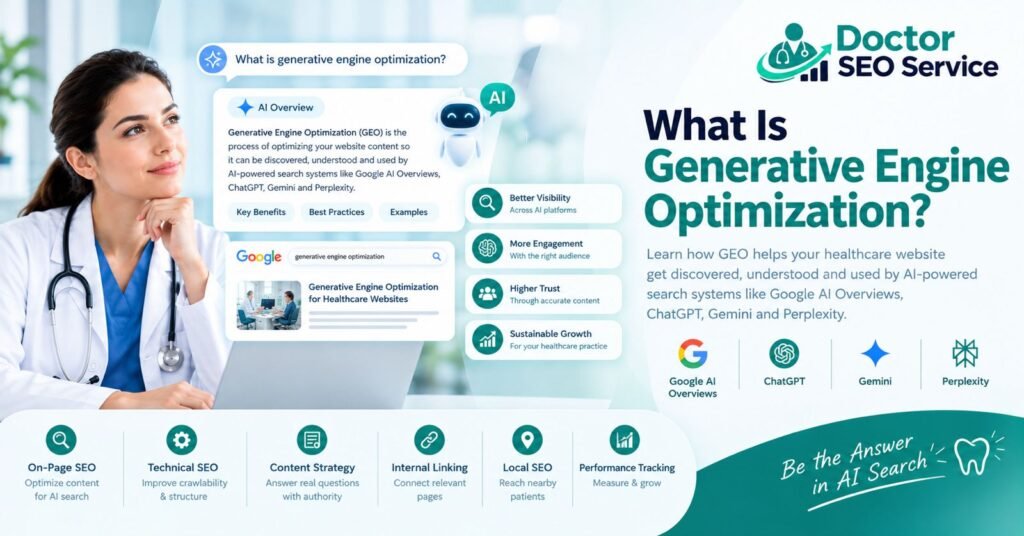
Generative Engine Optimization (GEO) is the practice of improving website content and online information so it has a better opportunity to be discovered, understood, and referenced by AI-powered search experiences. These experiences may generate answers using information retrieved from websites, search indexes, and other sources.
Traditional search engines often present a list of links for users to explore. AI-powered experiences, including Google’s AI Overviews and AI Mode, may also summarize information and provide links to supporting sources. Other AI assistants can help users research topics, compare options, and find businesses.
For healthcare organizations, this creates another reason to maintain accurate, useful, and accessible website content. A prospective patient might ask an AI assistant how to choose a physiotherapist, what questions to ask an IVF clinic, or how to evaluate a plastic surgeon’s qualifications.
A well-organized healthcare website can help answer these questions and provide a path for readers to learn more about the practice.
However, GEO does not guarantee that a website will appear in AI-generated answers. Google’s published guidance says that established SEO best practices remain relevant to its AI search features, and there are no special optimizations that guarantee inclusion.
In this guide, we’ll explain how GEO works, how it relates to traditional SEO, and how healthcare businesses can build a practical strategy for improving visibility across search experiences.
What Is Generative Engine Optimization?
Generative Engine Optimization is a digital visibility approach focused on helping content become a useful, accessible source for generative AI search systems.
Depending on the platform, AI systems may retrieve relevant information, evaluate available sources, and generate an answer that includes supporting links or citations. The exact process varies across platforms.
GEO generally focuses on:
- Publishing original, useful, and accurate content.
- Organizing information with clear headings and logical structure.
- Making important pages accessible to search crawlers.
- Maintaining accurate information about organizations and professionals.
- Supporting content with trustworthy sources and relevant expertise.
- Using structured data where appropriate.
- Measuring referral traffic, search visibility, and meaningful conversions.
GEO is closely related to traditional SEO and Answer Engine Optimization (AEO). These terms emphasize different aspects of search visibility, but their practical recommendations often overlap.
The objective is not to write for machines at the expense of people. It is to make genuinely useful information easy to discover, understand, and evaluate.
How Does Generative Engine Optimization Work?
AI-powered search systems do not all operate in the same way. Some use search indexes to retrieve relevant webpages, while other assistants may use different retrieval systems, connected sources, or model capabilities.
A simplified explanation of AI-assisted search includes the following stages.
1. Discovering and accessing content
Search systems need ways to discover available information. For websites, this can involve crawling public pages and following links.
If a healthcare website blocks important pages from crawling, relies on inaccessible content, or has broken internal links, search engines may have difficulty discovering its information.
For Google Search’s AI features, pages must meet the relevant technical requirements and be eligible to appear in Search. Google does not guarantee that every eligible page will be indexed or shown.
2. Retrieving relevant information
When a user asks a question, a search system may retrieve webpages and other sources relevant to that request.
For example, someone might ask:
“What should I look for when choosing an IVF clinic?”
A system may look for relevant information about clinic services, specialist qualifications, consultation processes, and reliable medical guidance.
A website that directly addresses the question with accurate information may be a useful candidate for retrieval, but relevance alone does not guarantee selection.
3. Interpreting and synthesizing information
Some generative search experiences combine information from multiple sources to produce a summarized answer.
Clear headings, specific explanations, consistent terminology, and meaningful context help human readers understand a page and can also make its information easier for search systems to interpret.
For example, a page titled “Questions to Ask During an IVF Consultation” can organize its content around preparation, the consultation process, treatment options, and questions to discuss with a qualified clinician.
4. Providing links or references
Depending on the platform and query, an AI-generated answer may display links to supporting webpages. The sources shown can vary between queries, platforms, and time periods.
GEO therefore focuses on improving the quality and accessibility of a website’s information—not trying to force a particular AI system to mention a brand.
GEO vs. Traditional SEO: What Is the Difference?
Traditional SEO helps websites become discoverable and competitive in search results. GEO focuses more specifically on the possibility of being discovered, used, or cited in generative AI search experiences.
The approaches overlap substantially.
| Area | Traditional SEO | GEO |
|---|---|---|
| Main objective | Improve organic search visibility | Improve discoverability and potential visibility in AI-generated search experiences |
| Content | Relevant, helpful, well-organized pages | Relevant, helpful pages that clearly answer questions and provide useful context |
| Technical foundation | Crawlability, indexability, site structure, performance | The same foundations, plus consideration of platform-specific access and retrieval |
| Authority and trust | Useful content, relevant reputation, credible sources | Credible, consistent information that can support trustworthy answers |
| Structured data | Used where appropriate for supported search features | Can help clarify information, but does not guarantee AI citations |
| Measurement | Search impressions, clicks, rankings, conversions | Available AI-search reporting, referral traffic, brand visibility, and conversions |
| Guaranteed results | Rankings cannot be guaranteed | AI citations or mentions cannot be guaranteed |
Google’s official guidance explicitly states that foundational SEO remains relevant to its generative AI search experiences. It also advises website owners to focus on valuable content and a clear technical structure rather than relying on supposed GEO hacks.
The practical lesson is simple: build a strong SEO foundation first, then evaluate how your content is discovered through the AI search experiences relevant to your audience.
Why Is GEO Important for Healthcare Websites?
Healthcare websites provide information that can influence important decisions. Patients may use search engines and AI assistants to research symptoms, compare providers, understand a service, or prepare for a consultation.
This makes accurate information and professional credibility particularly important.
Help patients find useful information
A physiotherapy clinic might publish a guide explaining what happens during an initial assessment. An IVF centre could describe the questions patients may wish to discuss with a qualified specialist. A plastic surgery practice could explain how to verify a surgeon’s qualifications.
Such pages can serve people researching a topic before they decide whether to contact a provider.
Present professional information clearly
Healthcare websites should accurately identify practitioners, qualifications, specialties, clinic locations, and services.
This information should be consistent across the website and other legitimate business profiles. Never invent qualifications, clinical outcomes, patient reviews, or professional affiliations to make a practice appear more authoritative.
Support trust through responsible content
Medical content should be reviewed by appropriately qualified professionals where necessary. Articles should distinguish general educational information from individualized medical advice and cite authoritative clinical sources when making medical claims.
GEO is not a substitute for clinical accuracy, ethical marketing, or patient privacy.
8 Practical GEO Strategies for Healthcare Websites
1. Answer the main question directly
Start important pages with a clear answer to the reader’s primary question, then expand with useful detail.
For example, an article titled “What Is Physiotherapy?” could begin by defining physiotherapy and explaining its general purpose before discussing assessments, treatment approaches, and when to seek professional advice.
Avoid lengthy introductions that delay the answer.
2. Use clear headings and logical content structure
Organize information into descriptive sections using a logical heading hierarchy.
For example, a healthcare article might include:
- What the service involves
- Who provides the service
- What to expect during a consultation
- Questions to discuss with a qualified professional
- How to contact the clinic
This structure improves readability and helps visitors find the information they need.
There is no universal word count or mandatory paragraph length that guarantees AI visibility. Choose the format that best serves the topic and audience.
3. Publish original information and practical expertise
Generic articles that repeat commonly available information may provide little reason for readers to choose one source over another.
Healthcare websites can add value by explaining genuine services, describing the consultation process, introducing qualified professionals, and answering relevant questions based on real experience.
For example, a physiotherapy clinic could explain how its first assessment is organized, what information patients should bring, and how follow-up appointments are arranged.
Publish only details that are accurate for the actual clinic.
4. Demonstrate experience, expertise, and trustworthiness
Provide clear author information and identify qualified medical reviewers when appropriate.
Useful trust signals include:
- Verified professional biographies.
- Accurate qualifications and specialty information.
- Relevant citations to authoritative sources.
- Clear publication and review dates where useful.
- Transparent contact and location information.
- A straightforward editorial correction process.
Do not claim that a clinician reviewed an article unless the review actually took place.
5. Make important content accessible to crawlers
Review your website’s technical foundations:
- Ensure important pages are not accidentally blocked.
- Check that public service pages can be indexed when intended.
- Maintain working internal links.
- Keep your XML sitemap accurate.
- Use HTTPS.
- Test mobile usability and page performance.
- Make essential information available as readable text.
- Avoid accidental
noindexdirectives on pages you want discovered.
Google’s AI search documentation emphasizes that existing SEO fundamentals—including crawlability, internal linking, page experience, and accessible text—remain important.
6. Use structured data accurately
Structured data can help search engines interpret details about an organization, person, article, or page.
Depending on the content, appropriate types may include Organization, Person, Article, BlogPosting, or BreadcrumbList.
Use markup that accurately reflects visible content and follows the relevant guidelines. Do not add invented reviews, credentials, services, or other information.
There is no special schema type that guarantees placement in AI-generated answers. Google states that additional AI-specific structured data is not required for its AI Overviews or AI Mode.
7. Maintain consistent business information
Keep the following information accurate wherever your business is represented:
- Organization or clinic name.
- Official website.
- Genuine physical location, where applicable.
- Contact details.
- Services offered.
- Professional names and qualifications.
- Appointment information and opening hours.
Consistency helps visitors verify information and reduces confusion between different pages or profiles.
For multi-location healthcare organizations, each location page should describe a genuine location and its available services.
8. Build meaningful relationships between related pages
Internal linking helps users explore your website and supports the discovery of important pages.
For example, an article about choosing a physiotherapist could link to your physiotherapy SEO service page. An article about fertility clinic marketing could link to the IVF-centre SEO service page.
Use descriptive anchor text and make sure the destination genuinely relates to the discussion.
Do not create dozens of near-identical pages merely to target slightly different question variations. Prioritize pages that provide distinct value.
Practical GEO Examples for Different Healthcare Specialties
GEO principles can be adapted to the real services a healthcare business offers.
Example 1: Physiotherapy clinic
Potential question: “What should I expect at my first physiotherapy appointment?”
A useful article could explain the general assessment process, what information a patient may be asked to provide, and how to prepare for the visit. Clinical recommendations should be reviewed by an appropriately qualified professional.
Related service: Physiotherapist SEO services.
Example 2: IVF centre
Potential question: “What questions should I ask during an IVF consultation?”
A helpful page could outline topics to discuss with a qualified fertility specialist, such as the consultation process, individualized treatment options, possible risks, costs, and follow-up arrangements.
It should avoid making guarantees about pregnancy or treatment success.
Related service: IVF centre SEO services.
Example 3: Plastic surgery practice
Potential question: “How can I evaluate a plastic surgeon’s qualifications?”
An educational article could encourage readers to verify professional credentials, understand the proposed procedure, ask about risks, and discuss their expectations directly with a suitably qualified surgeon.
Clinical content should be supported by reputable medical sources. The Cleveland Clinic’s overview of plastic surgeonscan serve as a starting point for general background reading.
Related service: Plastic surgery SEO services.
These examples illustrate a key principle: create useful content for real questions that your audience may have. Do not manufacture medical claims or assume that answering a question will automatically earn an AI citation.
Does GEO Require Special Files Such as llms.txt?
Some website owners explore files such as llms.txt to provide structured information for AI-related tools. However, these files should not be treated as a universal requirement for AI search visibility.
Google’s current guidance says that creating special AI text files or markup is not required for inclusion in its generative AI search features, and Google Search does not use llms.txt for that purpose. Other platforms may have their own documentation and practices, so check the guidance for the specific system you want to support.
Prioritize the fundamentals first: useful content, technical accessibility, accurate information, and a good user experience.
How to Measure GEO Performance
GEO should be evaluated using available evidence rather than unsupported claims about AI rankings.
Monitor search performance
Use Google Search Console to track organic impressions, clicks, queries, and the performance of important pages.
Google has also introduced reporting for visibility in its generative AI search features. Availability and the precise metrics shown can depend on the tools and reporting access available to your website.
Track website conversions
Use an appropriately configured analytics platform to measure meaningful actions such as:
- Appointment enquiry submissions.
- Contact form completions.
- Clicks on phone numbers.
- Visits to important service pages.
- Qualified leads and booked consultations, where available.
Protect sensitive information. Do not send patient names, medical conditions, or other sensitive health details to analytics platforms through URLs, event names, or tracking parameters.
Review AI visibility carefully
Where practical, monitor whether your brand or website appears in relevant AI search responses. Record the platform, query, date, and cited source, and repeat checks periodically.
AI answers can vary between queries and over time. A single appearance—or absence—is not enough to prove that a strategy is working or failing.
Frequently Asked Questions About GEO
1. What does GEO stand for in digital marketing?
GEO stands for Generative Engine Optimization. It describes practices intended to improve a website’s discoverability and potential visibility in generative AI search experiences.
2. Is GEO the same as SEO?
No, although the practices overlap. SEO covers the broader process of improving visibility in search engines, while GEO emphasizes visibility in AI-generated search experiences. Foundational SEO remains important for Google’s AI search features.
3. How can a healthcare website improve GEO?
Start by publishing accurate, useful content, using clear headings, identifying qualified authors, maintaining consistent business information, improving crawlability, and linking related pages. Measure performance using available search reporting and meaningful website conversions.
4. Does structured data guarantee AI citations?
No. Structured data can help search engines interpret page information, but it does not guarantee inclusion in an AI-generated answer, a citation, or a particular search position.
5. Does Google require an llms.txt file?
Google’s published guidance says that llms.txt is not required for its AI search features and does not improve Google Search visibility. Other systems may have different practices, so consult their official documentation where relevant.
6. Should healthcare businesses create separate content for every AI question?
Not necessarily. Create pages when they provide meaningful, distinct value. Publishing large numbers of repetitive pages solely to target query variations can reduce quality and may conflict with search spam policies.
7. Can AI-generated content be used on a healthcare website?
AI tools can assist with research, drafting, and organization, but content must be checked for accuracy, originality, relevance, and compliance with search policies. Medical content should receive qualified review when appropriate. Publishing large volumes of unreviewed or low-value material is not a sound strategy.
8. How long does GEO take to produce results?
There is no universal timeline. Discovery, indexing, visibility, and traffic depend on the website, competition, content quality, platform, and other factors. Neither rankings nor AI citations can be guaranteed.
Conclusion: Build a Sustainable GEO Strategy
Generative Engine Optimization is an emerging area of digital visibility focused on how websites can be discovered and used in AI-powered search experiences.
For healthcare organizations, the most practical approach is to combine strong traditional SEO with accurate, people-first content, accessible website structure, clear professional information, and responsible measurement.
Rather than chasing secret AI ranking techniques, focus on answering real questions, demonstrating genuine expertise, keeping business information accurate, and making your website useful to both prospective patients and search systems.
Improve Your Healthcare Website’s SEO and AI Search Readiness
At Doctor SEO Service, we help healthcare businesses strengthen their online presence through healthcare SEO strategy, technical website optimization, content planning, and local search improvements.
Explore our SEO services or request a free SEO audit to identify opportunities to improve your website’s discoverability and user experience.
Editorial note: This article discusses digital marketing and search optimization, not medical advice. Clinical information should be reviewed by a suitably qualified professional where appropriate.
Author: Add the actual author’s name and verified professional biography before publishing.
Medical reviewer: Include a qualified clinician’s name and credentials only if a genuine review has taken place.